
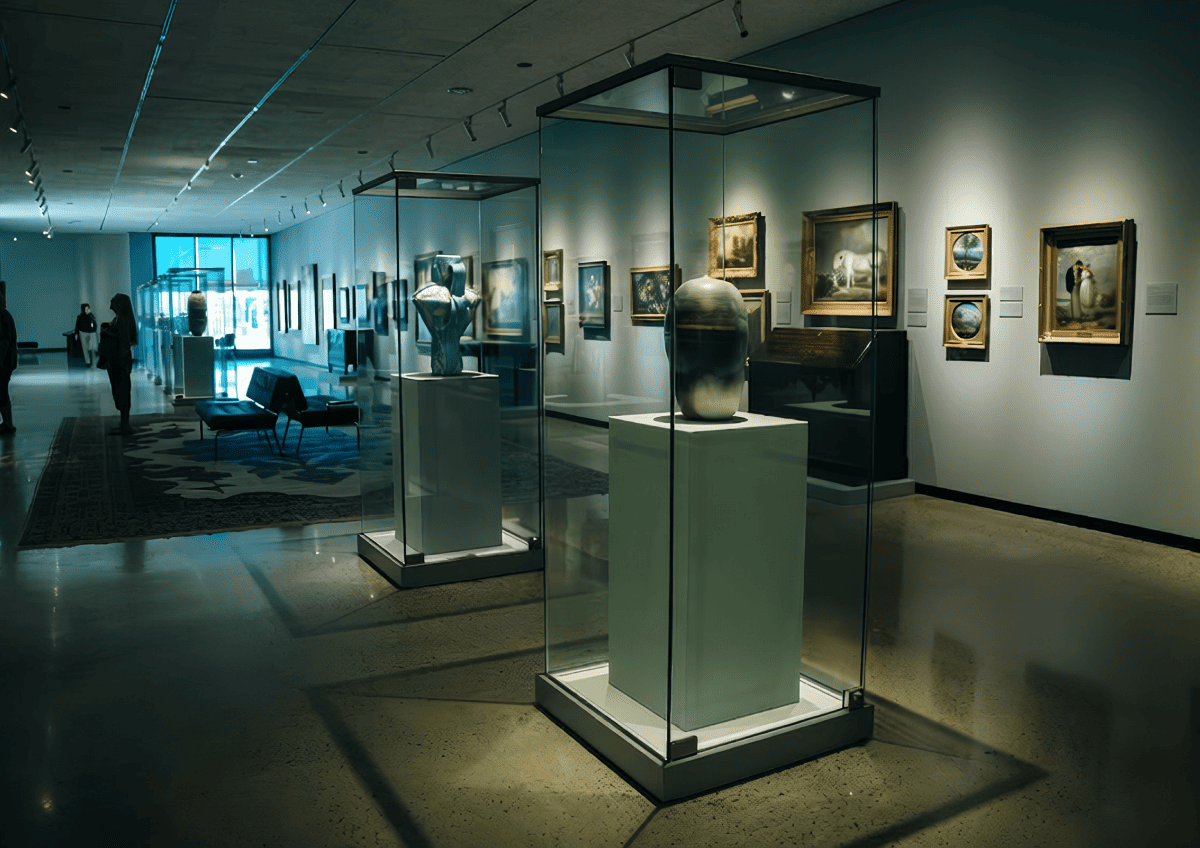
Museum equipment
Museum equipment in Uzbekistan
We make museum equipment for permanent and temporary exhibitions: display cases, information boards, podiums, holders, information structures and wayfinding. Making things just "look nice" is not enough, so we think through stability, ease of maintenance and careful presentation of exhibits.
We select solutions to suit the hall size, the visitor journey and the placement format: stationary elements, mobile structures and modular systems that can be rearranged for different exhibitions.
Exhibition equipment built for real-world use
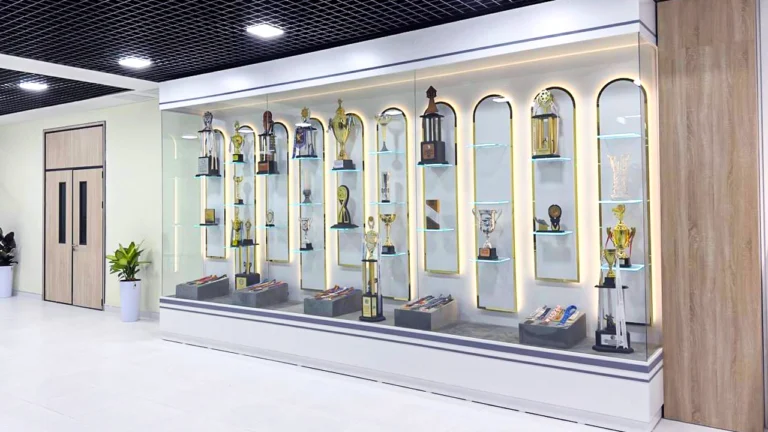
Display cases and information boards
Display cases, information boards, podiums, holders and wayfinding for permanent and temporary exhibitions.
Special projectors
Selection and installation of projectors, taking into account brightness, distance, projection angle and hall lighting.
Touch panels
Touch panels with catalogs, reference information, routes and educational materials for visitors.
Interactive panels
Panels for demonstrations, presentations and educational zones with on-screen control.
Touch tables
Tables for group work with content, convenient for both children and adults.
TES Tangible Engine
Interaction through physical objects and touch surfaces for a memorable exhibition.
LED screens
Supply and installation of LED screens with a pixel pitch matched to the viewing distance and venue.
3D projection mapping
3D projection mapping for artistic scenes, brand presentations and historical stories.
Made to size, with an estimate and timelines, in clear stages of work
After clarifying the requirements we prepare a quote, propose materials and the construction, and agree layouts and dimensions. Then come manufacturing, delivery and installation on site, with quality control and fine-fitting of details.
The service suits museums, cultural centers, exhibition venues and exhibition organizers. As a result you get equipment that looks neat on camera and withstands the daily load of visitors.
Ready to launch your advertising soon?
Write to us and we will quickly guide you through the possible solutions, agree on the materials and propose a launch plan.
We can join at any stage: from idea and design to production, placement and ongoing support.
Museum equipment: materials, timelines and technologies
Five types of museum display cases cover 90% of exhibition tasks
Each exhibit calls for its own structure. Tabletop display cases 90-120 cm high show small sculpture, coins, jewelry and manuscripts at eye level. Floor-standing display cases up to 200 cm high show costumes, weapons and full-length sculpture with an all-round 360° view. Wall-mounted models 8-20 cm deep attach to the wall and suit paintings, documents and bas-reliefs.
Horizontal table-type display cases with the top tilted at 15-30° suit books, maps and archaeological finds: the visitor sees a flat object without glare and without bending over. Domes of solid glass or acrylic cover a single object on a podium, leaving a minimum of visible fixings. For Aesthetic Pro in Tashkent these five formats are the basic building set from which the exhibition of any museum or gallery is assembled.
Low-iron museum glass transmits up to 91% of light without a green tint
Ordinary float glass gives a greenish tint at the edges and distorts the color of the exhibit. Low-iron (museum) glass is free of this defect and renders the shades of paintings and fabrics faithfully. Anti-reflective glass with matte etching or coating cuts mirror reflections to 1%: the display case "disappears" and only the object remains.
For safety, we use tempered glass 6-10 mm thick: when broken, it crumbles into blunt granules. Laminated glass (triplex) with a polymer interlayer holds the fragments and protects against impact, which makes it the mandatory option for expensive and unique exhibits. A combination of low-iron laminated glass with an anti-reflective layer is the standard for front-line display cases in galleries and museum collections of Uzbekistan.
| Equipment type | Glass | Protection | Lighting | Use |
|---|---|---|---|---|
| Tabletop display case | Low-iron anti-reflective 4-6 mm | Lock, opening sensor | LED CRI ≥90, 50-150 lx | Coins, jewelry, manuscripts |
| Floor-standing display case | Tempered/laminated 8-10 mm | Lock, sensor, vandal resistance | LED CRI ≥90 + UV filter | Costumes, weapons, sculpture |
| Wall-mounted display case | Museum low-iron 4-6 mm | Concealed lock, reed switch | LED contour lighting | Paintings, documents, bas-reliefs |
| Horizontal table display case | Anti-reflective laminated 6 mm | Lock, vibration sensor | LED diffused, 50 lx | Books, maps, archaeology |
| Glass dome | Low-iron laminated 6-8 mm | Magnetic lock, climate module | Fiber optics, no heat | Single valuable exhibit |
| Podium with dome | Tempered 8 mm + dome | Weight sensor, opening sensor | LED from below and along the contour | Sculpture, models, jewelry |
Stable humidity of 45-55% extends the shelf life of organic exhibits by decades
Wood, paper, leather, fabric and bone react to humidity swings with cracking and deformation. A sealed display case with an air leakage rate below 0.3 volumes per day holds the microclimate inside. For passive stabilization, the lower compartment is loaded with silica gel (Art-Sorb cassettes) at 1-2 kg per cubic meter of volume: it absorbs or releases moisture, holding the set range.
Active climate control with temperature and humidity sensors and a humidifier module is needed for display cases with especially sensitive exhibits and for rooms without stable air conditioning. In Tashkent's climate, with dry summers and seasonal humidity swings, this unit solves the main problem of long-term storage.
LED with CRI ≥90 and a UV filter lights an exhibit without fading
Ultraviolet and infrared heat destroy pigments and fibers. Museum LED fixtures with CRI ≥90 (ideally 95+) render color close to daylight and barely heat the object. A spectrum with no UV component and external UV filters on the glass reduce the light aging of paints and fabrics.
Illuminance is dosed according to conservation norms: 50 lux for graphics, watercolors and fabrics, up to 150-200 lux for oil paintings, up to 300 lux for metal and stone. Fiber-optic lighting moves the heat source outside the display case and delivers only cold light into the volume, a solution for the most delicate exhibits.
Display case protection is built in several layers: mechanical locks with a concealed cylinder, magnetic and reed opening sensors, vibration sensors and vandal-resistant laminated glass units. The sensor signal is routed to the museum's security system.
Frequently asked questions
What humidity should be maintained in a museum display case?
The optimal range is 45-55% relative humidity, kept stable without sharp daily swings. For organic materials (paper, wood, fabric, leather), Art-Sorb silica gel is placed inside at 1-2 kg per cubic meter, and for especially sensitive exhibits active climate control with sensors is installed.
How does museum glass differ from ordinary glass?
Museum low-iron glass transmits up to 91% of light and gives no green tint at the edges, whereas ordinary float glass distorts the color of the exhibit. The anti-reflective layer cuts mirror reflections to about 1%, and laminated glass adds impact protection and fragment retention.
What lighting is safe for exhibits?
Museum LED fixtures with CRI ≥90 and no ultraviolet in the spectrum are safe. Illuminance is dosed by norms: 50 lx for graphics and fabrics, up to 150-200 lx for paintings, up to 300 lx for metal and stone. For the most delicate items, fiber optics are used, moving the heat outside the display case.
What materials are display case frames made of?
The main frame materials are aluminum profile, steel and coated MDF. Aluminum gives a light, rigid structure and thin visible frames, steel is used in large floor-standing display cases under heavy loads, and MDF is used for cabinet plinths and podiums, painted or veneered to match the exhibition interior.
How long does museum equipment manufacturing take in Tashkent?
Serial display cases are made in 3-4 weeks on average, and complex projects for a specific exhibition with climate control and custom glazing take from 4 to 8 weeks. Aesthetic Pro gives the exact lead time after measurements, drawing approval and selection of glazing and protection for your exhibits.