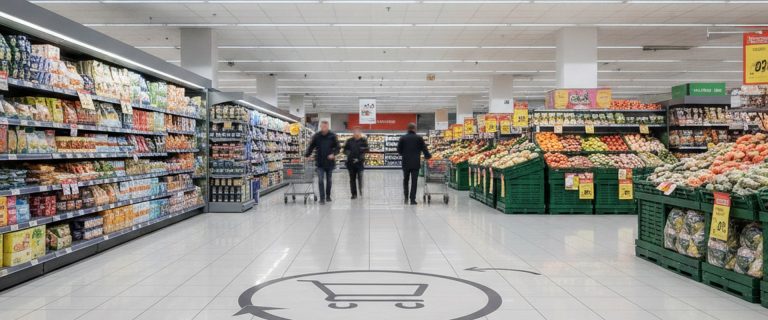

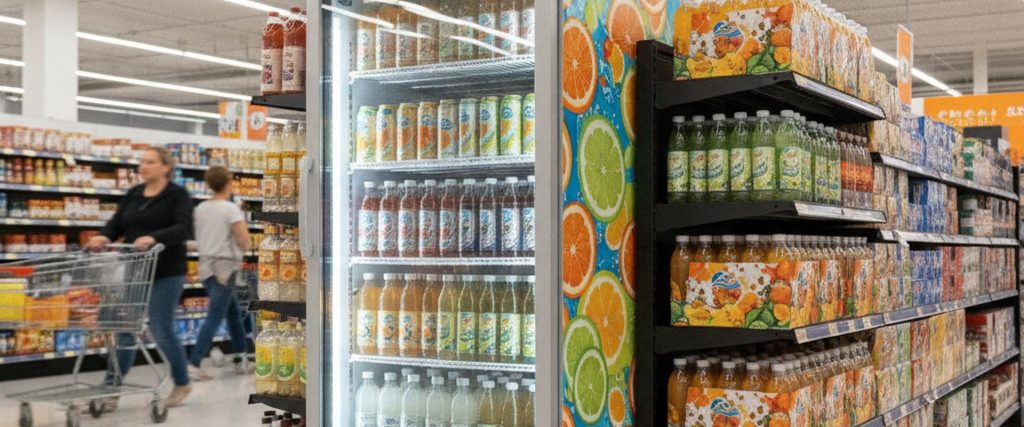
A branded refrigerator in a supermarket aisle works as a three-dimensional sign: it is visible from 10-15 meters, takes up a ready-made place in the hall and sells the manufacturer's product without a markup for advertising space. For an FMCG brand, it is one of the cheapest ways to "stake out" a shelf. Below: what exactly is branded at a point of sale, what film is used to wrap refrigerated chests and curved corners, how a magnetic overlay differs from wrapping, and how long it all lasts under condensation and daily cleaning.
What Equipment Branding Delivers
Branding is the wrapping and fitting-out of retail equipment with corporate graphics: printed film on the body, a topper on top, price tag holders and shelf talkers on the shelves. The goal is to turn a neutral refrigerator, rack or pallet into a branded medium that makes the product stand out in the overall display and secures the brand's place in the hall. In trade marketing this is a standard mechanic: a manufacturer of beverages, beer, ice cream or dairy provides branded equipment to retail and in return gets priority display.
Unlike paper POS materials, equipment lives for years and cannot be torn off by staff: the graphics become part of the refrigerator itself. That is why the requirements for materials are higher: the film must withstand condensation on refrigerated surfaces, daily washing and a temperature swing from −20 °C inside a freezer chest to +30 °C in the hall.
What Is Branded at a Point of Sale
The medium is chosen for the equipment type and the campaign budget: permanent equipment needs wrapping, a temporary activation needs quick-removal elements. The main objects and methods are in the table.
| Equipment | Method | Medium |
|---|---|---|
| Refrigerated display, cabinet | Wrapping with cast film | Body, side panels, frieze |
| Freezer chest | Freeze-resistant film + topper | Lid, sides, crown |
| Rack, gondola | Film + shelf talkers | End panels, shelves, back panel |
| Pallet, promo island | Cardboard/PVC skirt | Pallet side, topper |
| Promo table, cart | Wrapping + magnetic overlay | Front, countertop |
Most often a set is ordered: body wrap plus a crown topper and shelf talkers in a single design. A topper raises the equipment's height by 20-40 cm and makes it visible above the racks; it is printed on 3-5 mm PVC or foam board and attached to the body. For chain campaigns repeatability matters: one layout is adapted to several refrigerator models so that the brand looks the same at all outlets.
Materials and Technologies
The basis of branding is self-adhesive film. Calendered film suits flat surfaces; for refrigerators with complex geometry only cast film of 50-80 microns will do: it stretches over corners, door handles and curved sides without lifting or shrinking. Printing is done with UV or eco-solvent inks up to 1440 dpi, with a laminate on top to protect against washing and ultraviolet. The materials are summarized in the table by task.
| Your task | Material | Feature |
|---|---|---|
| Flat panels, fronts | Calendered PVC | Cheaper, for even surfaces |
| Corners, handles, curved shapes | Cast film | Stretches and follows the relief |
| Freezer chest, outer walls | Freeze-resistant film | Low-temperature adhesive |
| Repeated design changes | Magnetic vinyl | Comes off without a trace, replaced in a minute |
| Topper, crown | 3-5 mm PVC / foam board | Rigid printed panel |
A separate solution is magnetic overlays (brand frame): printing on magnetic vinyl that holds on the steel body of a refrigerator without adhesive. They are chosen when the design changes often: a new campaign goes up in a minute, without taking the equipment out of the hall or re-wrapping the film. The downside is that magnetic vinyl costs more per square meter and works only on a ferromagnetic surface. Wrapped film is cheaper and more reliable for long placements, but harder to change.
Service Life and Installation
Wrapping with cast film with laminate lasts 2-4 years with indoor placement and daily washing; freeze-resistant film on a chest holds the same period under constant condensation. Magnetic overlays are practically eternal: only the print life is limited, as it fades in 2-3 years under bright light. PVC toppers outlive the body and move from one piece of equipment to another.
Installation is done on site at the point of sale. The surface is washed, degreased and dried; on a refrigerator it is especially important to remove the condensation film and greasy deposits, otherwise the adhesive will not bond. The film is pressed down with a squeegee, with corners worked with a heat gun for better adhesion on bends. Full bonding takes 24-48 hours, so the equipment is not washed on the first day. Removing the old wrap is a separate operation involving heating and adhesive cleaning.
Who Needs Equipment Branding
The main customer is FMCG manufacturers: beverages, beer, energy drinks, ice cream, dairy, where a refrigerator at the entrance brings direct sales and pushes the competitor off the shelf. Retail chains brand their own private-label zones and promo islands. Distributors equip outlets with branded equipment under display contracts. For seasonal activations magnetic overlays and toppers are used, to quickly re-dress the refrigerator fleet for a new campaign across the whole chain.
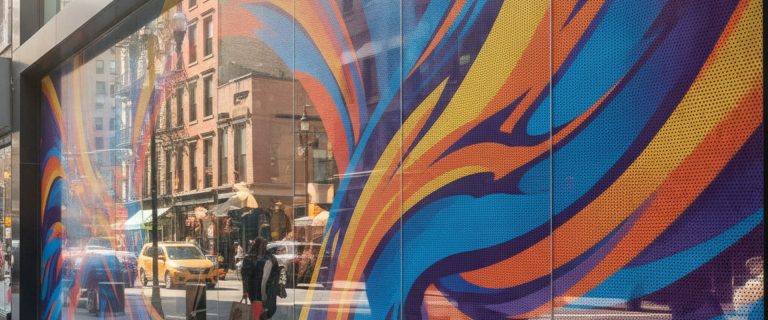
Equipment branding is the top level of POS design and relies on a combination of media. On the shelves it is continued by wobblers and shelf talkers, in the promo zone by promo stands and floor displays, and the body material is chosen by the same criteria as described in the breakdown of POS materials made of cardboard, PVC and acrylic. The film for retail equipment is printed on the same machines as window film graphics. Together this gives a single brand style from the entrance to the checkout; more in the overview of types of POS materials.
Frequently Asked Questions About Equipment Branding
Can a refrigerator be wrapped without switching it off?
The outer walls, yes: installation is done on running equipment. It is only important to remove condensation and degrease the surface before wrapping, otherwise the adhesive will not bond. Inner surfaces and freezer chests sometimes require defrosting so that the film lies on a dry wall without ice.
How long does branding last?
Wrapping with cast film with laminate lasts 2-4 years with daily washing; freeze-resistant film on a chest lasts the same under condensation. Magnetic overlays practically do not wear out, only the print life is limited (2-3 years under bright light). PVC toppers outlive several campaigns.
How is a magnetic overlay better than wrapping?
Magnetic vinyl is removed and replaced in a minute with no re-wrapping and no adhesive traces, which is convenient when the design is updated for every promotion. Film wrapping is cheaper and more reliable for long placements, but harder to replace. A magnet works only on a steel ferromagnetic body.
Will the film withstand washing and low temperatures?
Yes, with the right choice of material. Cast film with laminate is designed for daily wet cleaning, and freeze-resistant film for an adhesive that does not let go at −20 °C inside the chest and +30 °C outside. Ordinary cheap film must not be used on refrigeration equipment: it peels off from condensation.
Can the film be removed without harming the equipment?
Yes. The film is heated with a hot-air gun and removed as a sheet, and the adhesive residue is removed with solvent. A painted or steel body is not damaged by careful removal. Cast films come off cleaner than calendered ones, so they are chosen for equipment that will be returned to its owner.
How do I order branding for a chain of outlets?
The design is developed once and adapted to the equipment models in the chain, then a run of films and toppers is printed according to the number of outlets. Installation is planned by the store visit schedule. For the calculation we need a list of refrigerator models, their dimensions and the number of outlets; from these we work out the film area and the kit contents.
We will make it to fit your task: order turnkey outdoor advertising with a cost and lead-time estimate.