
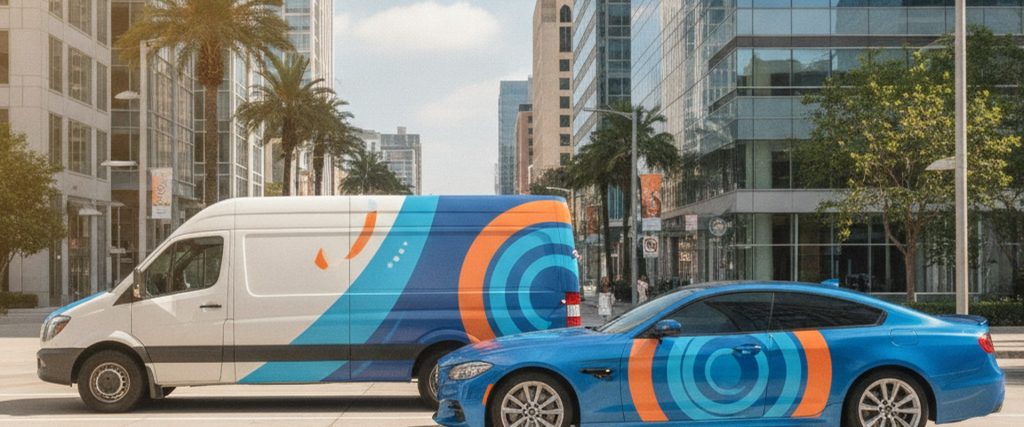
One branded car delivers 30,000-70,000 advertising contacts a day: that is how many people see it in traffic, in the car park at a shopping center and in residential courtyards. At the same time, a wrap needs no approval from the khokimiyat (city administration), unlike a sign or billboard, and lasts several years as a one-off investment. Below: which films are used to brand vehicles, how long they last, how a partial wrap differs from a full one, and how to order the work in Tashkent without bubbles and peeling a month later.
What vehicle branding gives you
Car advertising is transit (moving) outdoor advertising that works wherever your vehicle stands and drives: at the office, on a delivery route, in a shopping-center car park. The main difference from static outdoor advertising is mobility and a low cost per contact: the film is applied once and reminds people about the brand for years without monthly rent for an advertising site.
- Reach without rent. A company or courier fleet drives around the city anyway; branding turns those kilometers into advertising for free.
- No approvals. Advertising on your own vehicle, as a rule, does not require permission from city authorities, so the campaign can be launched immediately.
- Body protection. The film shields the factory paint from small scratches, chips and ultraviolet light; when it is removed, the paintwork is left in its original condition.
- Flexibility. The design can be changed for a promotion or a rebrand without repainting the car.
Types of wrap: partial, full, magnetic
The choice depends on the budget and how much of the body needs to be covered. A partial wrap (sides, doors, rear door) is the most popular format for company vehicles: it covers the key surfaces seen by pedestrians and by drivers nearby, and costs several times less than a full one. A full wrap covers the entire body, including complex curves, and turns the car into a single art object; it is chosen for promo cars and image campaigns.
| Wrap type | What is covered | Film | When to choose |
|---|---|---|---|
| Partial | Doors, sides, rear door | Calendered / cast | Company fleet, budget |
| Full (full wrap) | Whole body + curves | Cast | Promo car, image, color change |
| Magnetic panels | Flat sides, doors | Magnetic vinyl | Car rental, removable advertising |
| Logo/contacts only | Doors, glass | Plotter cutting | Minimum budget, taxis |
Magnetic panels are a separate option: they are taken off for weekends or when a rental car is returned. But a magnet holds only on flat steel surfaces and is not suitable for aluminum and plastic parts, so it is a compromise, not a full replacement for film.
Which films are used
The service life and appearance of a wrap are determined by the type of vinyl. Films fall into two classes, cast and calendered, and the difference between them is fundamental precisely on a car, with its curves, rivets and corrugations.
Cast films
Cast vinyl is cast from liquid PVC: it comes out thin (50-110 µm), flexible and shows almost no shrinkage. Such film stretches over complex shapes (bumpers, mirrors, recesses) and does not lift at the edges. This is the "gold standard" for a full wrap. Working series: Oracal 751C (high-quality graphics, up to 8 years), Oracal 970RA, a specialized film for full wraps 110 µm thick with RapidAir technology for bubble-free application: up to 10 years for black and white, up to 8 years for colors, about 4 years for metallics.
Calendered films
Calendered vinyl is rolled between rollers: it is thicker (70-80 µm), stiffer and has a "memory": over time it shrinks and may lift at the edges on curves. On the other hand, it is cheaper and works very well on flat surfaces. Oracal 641 is economy class (1-3 years; on a car it is better to remove it after a year), Oracal 651 is an all-rounder lasting up to 6 years on the flat sides of vans, Oracal 551 is an economical polymeric film for full wraps of mid-range cars (3-5 years).
| Film | Class | Thickness | Service life | Suited for |
|---|---|---|---|---|
| Oracal 641 | Calendered economy | 75 µm | 1-3 years | Short promotions, flat surfaces |
| Oracal 651 | Calendered all-rounder | 70 µm | up to 6 years | Van sides, partial wrap |
| Oracal 551 | Polymeric | — | 3-5 years | Economy full car wrap |
| Oracal 751C | Cast | ~50 µm | up to 8 years | Graphics, complex shapes |
| Oracal 970RA | Cast wrap | 110 µm | 8-10 years | Premium full wrap |
Why lamination is needed
Lamination is a clear protective layer over the printed image. On color print it is mandatory: without it the warranty on the wrap is reduced, and scratches appear on the film after the first few washes. The laminate filters ultraviolet (the colors do not fade), protects against road salt, de-icing agents and fuel vapour, makes the surface washable and gives the required finish: gloss, matt or satin. For a long service life, cast print is laminated with cast laminate.
How long a wrap lasts
A high-quality cast film with lamination, professionally installed, lasts 5-7 years. But the actual life depends on four factors, not only on the vinyl brand.
| Factor | How it affects |
|---|---|
| Material | Cast + laminate = 5-7 years; economy calendered without laminate = 1-2 years |
| Installation | Crooked installation leads to bubbles and peeling within months; a clean, dry body is a must |
| Conditions | Constant sun and temperature swings shorten the life; a garage extends it |
| Care | Washing without a pressure washer at close range and gentle chemicals extend the life |
Horizontal surfaces, the bonnet and roof, wear faster than the vertical sides because the sun hits them at a right angle. If the car spends the night in a garage, the film lives noticeably longer than stated. We wrote in detail about how ultraviolet light and climate affect various advertising coatings in our article on the service life of outdoor advertising.
How to order car branding in Tashkent
The workflow: we take the body measurements (or use the factory template of the model), prepare the design layout and agree it with you, print on film and laminate, then apply to a clean, dry car in a heated bay. Installation requires a stable temperature: in the cold the film does not stretch and sticks poorly, so wrapping is done indoors. After installation the film needs 1-2 days for final adhesion; during this time it is better not to wash the car.
Vehicle branding is best planned together with the rest of your identity: the same colors and logo as on outdoor advertising and shop-window decoration with film. The right choice of vinyl and laminate for the task is half the result; the other half is careful installation, whose importance we discuss in the review of materials for outdoor advertising.
Frequently asked questions about car wraps
Does a wrap damage the factory paint?
No, quite the opposite: quality film protects the paintwork from scratches, chips and ultraviolet light. When removed, it does not damage sound factory paint. There is a risk only where there was already rust, touch-up paint or peeling lacquer under the film.
How long does advertising on a car last?
Cast film with lamination, professionally installed, lasts 5-7 years. Economy calendered vinyl without laminate lasts 1-2 years. The actual life depends on operating conditions: garage storage extends it, constant sun shortens it.
How does a partial wrap differ from a full one?
A partial wrap covers the doors, sides and rear door: it is cheaper and enough for company vehicles. A full wrap covers the whole body, including curves and bumpers, requires cast film and costs several times more; it is chosen for promo cars and color changes.
Does advertising on your own car need to be approved?
As a rule, advertising on your own vehicle does not require permission from city authorities, unlike signs and billboards. This is one of the advantages of the format: the campaign can be launched immediately after wrapping. Separate requirements may apply to taxis and public transport vehicles.
Can the advertising be removed without a trace?
Yes. Cast films are removed with heat and leave no adhesive on sound paintwork. Economy calendered vinyl after several years in the sun is harder to remove and may leave adhesive residue, so such films are recommended to be replaced in time. A fully removable option is magnetic panels.
How long does it take to wrap a car?
A partial wrap of a passenger car takes from one day, a full wrap 2-4 working days including printing, lamination and installation. After installation the film needs 1-2 days to bond, during which the car is not washed.
We will make it to fit your task: advertising production in Tashkent with a cost and lead-time estimate.