
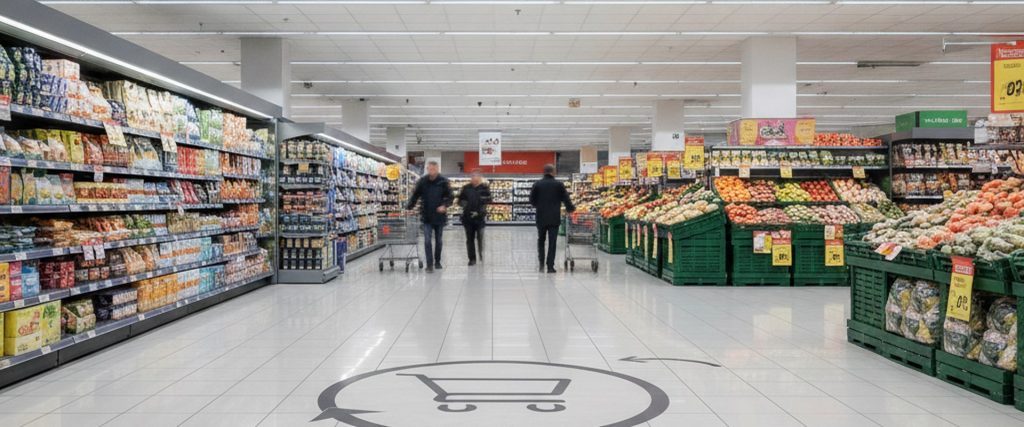
The floor in a sales area is up to 30% of the advertising space, which usually nobody uses. A floor sticker leads the customer to the right shelf, marks out a promo zone and works where the eye is looking down: at the checkouts, in the queue, in front of the entrance. Below: what floor graphics are made of, how indoor film differs from asphalt film, how long the covering lasts on tile and outdoors, and how to install it properly so that it does not slip or peel off within a week.
What Floor Advertising Is
Floor advertising is self-adhesive film with full-color print and a protective anti-slip laminate, applied directly to the floor: tile, porcelain stoneware, laminate flooring, poured floor, concrete or asphalt. The construction has three layers: cast PVC film 80-100 microns thick with reinforced adhesive, the print on top of it and, on top of that, a floor laminate with a rough texture. It is the laminate that sets a floor sticker apart from an ordinary one: it withstands the abrasion of thousands of soles a day and prevents slipping.
The key parameter is the slip-resistance class per DIN 51130, from R9 to R13. For a dry sales area, R10 laminate is used; for entrance areas where moisture and snow are brought in, R11. A class below R9 must not be used in a walkway: a wet sticker becomes an injury hazard. Serious manufacturers have a slip-resistance certificate for their floor laminate, and it is worth requesting before ordering.
Types of Floor Graphics
The film and laminate are chosen for the surface and the duration: what lasts half a year on a hypermarket's tile will wear off in two weeks on outdoor asphalt. The main types are in the table.
| Type | Surface | Service life | Where it is used |
|---|---|---|---|
| Indoor film with R10 laminate | Tile, porcelain stoneware, laminate flooring | 3-6 months | Navigation in the hall, promo zones |
| Indoor film with reinforced R11 laminate | Entrance areas, wet zones | 4-8 months | Vestibules, checkout area, cloakroom |
| Asphalt (street graphics) | Asphalt, paving tiles | 1-3 months | Parking lots, street entrance, events |
| Stencil paint / template | Concrete, asphalt | 2-6 months | Markings, logo at the entrance |
| 3D sticker (stereo effect) | Level tile | 2-4 months | Viral campaigns, photo zones |
For a store, indoor film is chosen in 90% of cases: a circle 30-100 cm in diameter, a rectangle or a shaped die-cut for an arrow, a footprint or a product silhouette. Street promotions at the entrance are applied on asphalt film with a coarse texture: it is designed for direct contact with footwear and precipitation, but lasts noticeably less and costs more per square meter. 3D stickers are ordered for one-off campaigns: the volume effect catches attention, but requires a perfectly level floor and the right viewing angle.
Printing and Materials
The image is printed on a wide-format plotter with eco-solvent, latex or UV inks at up to 1440 dpi, which is enough for a logo and text to be read from a person's eye height. The base is cast film, not calendered: cast is thinner, stretches better over uneven tile with joints and does not shrink. After printing, the floor laminate is applied by the cold method; for shaped stickers the contour is cut on a plotter followed by weeding.
Joints between tiles are the main enemy of floor graphics. On a large-format sticker the film sinks into the grout joints and wears through there first. That is why for large formats one chooses either whole zones without joints (poured floor, linoleum) or cuts the layout into modules sized to the tile. The printing technology here is the same as for banners and window film; only the laminate and the adhesive layer differ.
Service Life and What It Depends On
The service life of a floor sticker is determined by three factors: the foot traffic of the spot, the surface and the laminate class. The table gives real reference values for a sales area.
| Foot traffic | Surface | Laminate | Service life |
|---|---|---|---|
| High (hypermarket, shopping mall) | Porcelain stoneware | R11 | 2-4 months |
| Medium (neighborhood store) | Tile, laminate flooring | R10 | 4-6 months |
| Low (boutique, office) | Laminate flooring, poured floor | R10 | 6-12 months |
| Outdoors | Asphalt | Street laminate | 1-3 months |
When planning the budget of a promo campaign, the sticker's life is tied to the promotion's duration with a 20-30% reserve: a one-month promotion calls for laminate with a 2-month life. Saving on laminate class does not pay off: a sticker worn off in two weeks damages the brand impression more than its absence. Removal is included in the project cost: the old film is heated and peeled off, the adhesive residue is removed with solvent, otherwise the new film will lie in bumps.
Installing Floor Graphics
The sticker is applied to a clean, dry and degreased floor at a temperature of no lower than +10 °C. The surface is washed, degreased and left to dry completely: on wet tile the adhesive will not bond. The film is positioned, the backing is removed and the sticker is pressed down with a hard roller or felt squeegee from the center to the edges, pressing the tile joints in thoroughly. Full adhesion is reached after 24-48 hours; during this period it is better not to wash the zone with aggressive chemicals. Outdoors, installation is done only on dry asphalt in warm weather: on a wet or cold surface street graphics will not stick.
Where Floor Advertising Works
The floor delivers results where the decision is made by the feet, not the eyes. In navigation arrows and footprints lead to the promo section or a new product, which is cheaper than rehanging overhead signs. In promo zones a colored circle under a pallet or stand outlines an "island" and increases the time spent at the product. At checkouts and in queues markings organize the flow and sell impulse goods at the same time. At the street entrance a branded platform works as an extension of the signage. The floor is especially strong in FMCG activations: the shopper literally steps onto the brand.
Floor graphics rarely work alone: they are part of the hall's navigation and POS design system. From above, the flow is guided by navigation plaques and wayfinding signs, at the shelf itself there are POS materials, and the promo zone is anchored by promo stands and floor displays. Floor film is printed on the same equipment as window film graphics: only the protective laminate differs. Together, the floor, the shelf and the window lead the shopper along a single scenario.
Frequently Asked Questions About Floor Advertising
Is a floor sticker slippery?
No, if floor laminate of the right class is used. For a dry hall, R10 per DIN 51130 is used; for entrance areas and wet zones, R11. Such laminate feels rough to the touch and is no worse than the tile itself in friction coefficient. Ordinary film without floor laminate must not be applied to a floor: it is an injury hazard.
How long does floor advertising last in a store?
From 2-4 months in a high-traffic hypermarket to 6-12 months in a boutique or office. Outdoors (asphalt) the life is shorter, 1-3 months. The life depends on foot traffic, surface and laminate class, so it is chosen to match the promotion's duration with a 20-30% reserve.
What surfaces can it be applied to?
To tile, porcelain stoneware, laminate flooring, linoleum, poured and concrete floors, and asphalt; each surface needs its own type of film and adhesive. Smooth seamless floors hold the graphics longest. On tile with wide joints, the sticker is cut into modules sized to the tile so that it does not wear through at the joints.
Can a sticker be removed without a trace?
Yes. The film is heated with a heat gun and removed as a whole sheet, and the adhesive residue is cleaned off with a special solvent. Tile and porcelain stoneware are not damaged. From porous concrete and old asphalt the adhesive comes off less well, and a faint outline sometimes remains, which fades over time.
What are the minimum run and the production time?
You can print from a single sticker, but it is more economical to order a zone or a set for a chain. The standard production time is 2-4 working days for printing and lamination plus installation. Shaped die-cutting and large formats add 1-2 days. For chain activations the run is calculated by the number of outlets and the elements per outlet.
Why is floor advertising better than hanging signs?
It falls into the field of view at the moment the shopper chooses a route and needs no ceiling mounting: the sticker is changed in a single visit for each promotion. The floor does not compete with other advertising at eye level and gives physical contact with the brand. The best result comes when floor navigation works together with hanging and shelf media.
We will make it to fit your task: sign and outdoor advertising production with a cost and lead-time estimate.