
A cardboard display turns a pallet or the end of a shelf into a separate point of sale: the product stands on a branded structure instead of getting lost in the general row. For FMCG it is the fastest way to support a promotion: the display is assembled in a minute, ships as a flat pack and costs several times less than a metal stand. We will look at how a showbox differs from a pallet display, what corrugated board they are made of, and which print runs make sense for a store chain in Uzbekistan.
What a cardboard display is and why it is needed
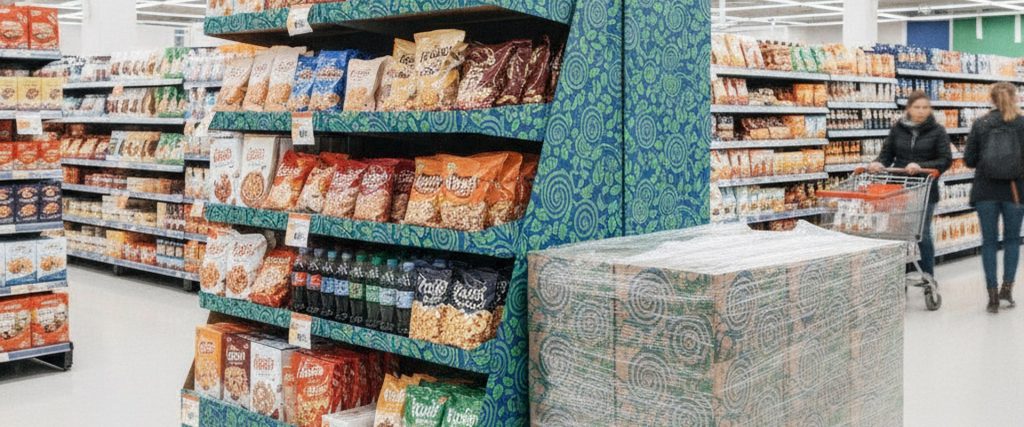
A cardboard display is a ready-made advertising structure made of corrugated board for displaying and selling goods right on the sales floor. Unlike ordinary packaging, a display works as a mini-stand: it holds its shape under the weight of the products, carries the brand print and is placed in a walkway or at the checkout. Its main advantages over permanent retail equipment are price, speed of production and logistics: the structure arrives flat and is assembled without tools.
Displays are ordered for a specific promotional activity: the launch of a new SKU, a seasonal promotion, a tasting. Once a display has served its campaign, it is disposed of or sent for recycling rather than kept in a warehouse. That is why cardboard wins where a short life and a large run for the whole chain matter.
Types of cardboard displays
Displays are distinguished by their place in the store and the volume of goods they hold. The main types are in the table.
| Display type | Place in the store | Product volume | Your task |
|---|---|---|---|
| Showbox (checkout) | Checkout, shelf | 10-40 units | Impulse purchase, small products |
| Shelf display box (shelf-ready) | Rack shelf | One layer of packs | Ready-to-sell layout, quick restocking |
| Floor display (stand) | Aisle, gondola end | 3-6 shelves of goods | A separate point of sale for a promotion |
| pallet display | On a pallet in the aisle | A full pallet | Mass display, wholesale, hypermarket |
| Dump bin (basket) | Aisle, entrance | Loose, in bulk | Sale, goods sold in sets |
Showbox is the most popular format: a box with a fold-down or tear-off front panel in which the product stands facing the shopper right at the checkout. Shelf-ready display (shelf type) saves the merchandiser's time: the packs arrive in a tray that is placed on the shelf as a whole, without arranging them one by one. Floor stand and pallet display are already full-fledged points of sale for 3-6 shelves or an entire pallet; they are placed in an aisle for a specific campaign.
What cardboard displays are made of
The strength and appearance of a display are determined by the grade of corrugated board: a combination of the profile (flute height) and the number of layers. The higher the load, the thicker the profile. Reference values are in the table.
| Corrugated board | Profile (flute) | Thickness | Where used in a display |
|---|---|---|---|
| Micro-flute E | 1.1-1.5 mm | Thin | Showboxes, trays, light products |
| Profile B | 2.5-3 mm | Medium | Shelf displays, stand walls |
| Profile C | 3.5-4 mm | Medium-high | Shelves and bases of stands |
| Double-wall BC/BE (triplex) | 6-7 mm | High | Pallet displays, heavy products |
For a light checkout showbox, E micro-flute is enough: it gives a smooth surface for quality printing. A floor stand is built from B or C profile: the walls hold their shape and the shelves do not sag under 3-5 kg of goods. For heavy displays (water, canned food, household chemicals), double-wall BC triplex is used: it withstands the weight of a full pallet and stacking in transit. Shelves are reinforced with extra inserts and stiffening ribs at points of maximum load.
Printing and assembly
The printing method is chosen by the print run. Small and medium runs are printed wide-format or on offset sheets followed by mounting (gluing the printed sheet onto the corrugated board), which gives photorealistic quality for branding. Large runs of thousands of pieces go to flexo printing directly on the board: cheaper per unit, but with limited detail. Lamination or varnish is applied over the print for moisture resistance and a presentable look under shop spotlights.
The key advantage of cardboard displays is flat-pack shipping. The structure arrives flat, in a stack, and is assembled on site along the folds and locks in 1-3 minutes without glue or tools. This sharply reduces the cost of delivery across the chain and makes it possible to keep a stock of displays in the warehouse without taking up volume. Complex floor stands are supplied partly assembled: the frame and, separately, the shelves.
Print runs and lead times
The economics of a cardboard display depend on the print run: the larger the batch, the lower the price per piece, because the cost of tooling (the cutting die) is spread across the whole order. Checkout showboxes make sense to order from 100-300 pieces, floor stands from 30-50 per chain, pallet displays for a specific delivery. Production time is usually 5-14 days, depending on the run, the printing method and whether new die-cutting tooling is needed or a standard one will do.
Where cardboard displays are used
Cardboard displays are a tool of FMCG brands and retail chains. The manufacturer orders them to get a separate display in the shop for a product launch, in addition to the standard shelf. The chain uses displays for seasonal and promo campaigns, when many outlets need to be dressed quickly and identically. Advertising agencies take displays for BTL projects and tastings. The common scenario is the same: a temporary, bright and cheap point of sale that can be rolled out in hundreds of shops in a single delivery.
On the sales floor, displays work together with other media. Next to a floor display, place promo stands and floor displays made of more durable materials, and the product on the shelf is supported by checkout stands for the impulse zone, while the choice between cardboard and durable materials is covered in the comparison POS made of cardboard, PVC and acrylic. The display itself is part of the overall system of POS materials for retail, which is ordered as a single set for a campaign.
Frequently asked questions about cardboard displays
How does a showbox differ from a pallet display?
A showbox is a small box for 10-40 units of product, for the checkout or a shelf, designed for impulse purchases. A pallet display is a large structure for a whole pallet of goods, placed in a hypermarket aisle for mass display. The difference is in the volume of goods and the place in the store.
How much weight of product can a cardboard display hold?
It depends on the corrugated board. E micro-flute holds light small items, B/C profile holds shelves with 3-5 kg per level, and double-wall BC triplex withstands heavy displays (water, canned food) and the weight of a full pallet. Shelves are reinforced with inserts for the maximum load.
Does the display arrive assembled?
No, and that is where the savings are. Displays are shipped in flat stacks and assembled on site along the folds and locks in 1-3 minutes without glue or tools. Flat shipping reduces the cost of delivery across the chain and saves warehouse space. Complex stands are supplied partly assembled.
What print run of cardboard displays makes sense?
Checkout showboxes from 100-300 pieces, floor stands from 30-50 per chain, pallet displays for a specific delivery. The larger the run, the lower the price per piece, because the cost of die-cutting tooling is spread across the whole order.
How long does a cardboard display last?
A cardboard display is designed for the duration of a single promotion, from a few weeks to 2-3 months. It is a disposable medium: once it has served its campaign, it goes for recycling. For permanent displays that last for years, PVC, acrylic or metal are chosen instead of cardboard.
Can a photo and a logo be printed on a display?
Yes. Small and medium runs are printed wide-format or by offset with mounting, which gives photorealistic quality. Large runs go to flexo printing on cardboard: cheaper, but with less detail. Varnish or lamination is applied over the top for moisture resistance and brightness under shop lighting.
We will make it to fit your task: custom POS materials in Tashkent with a cost and lead-time estimate.