

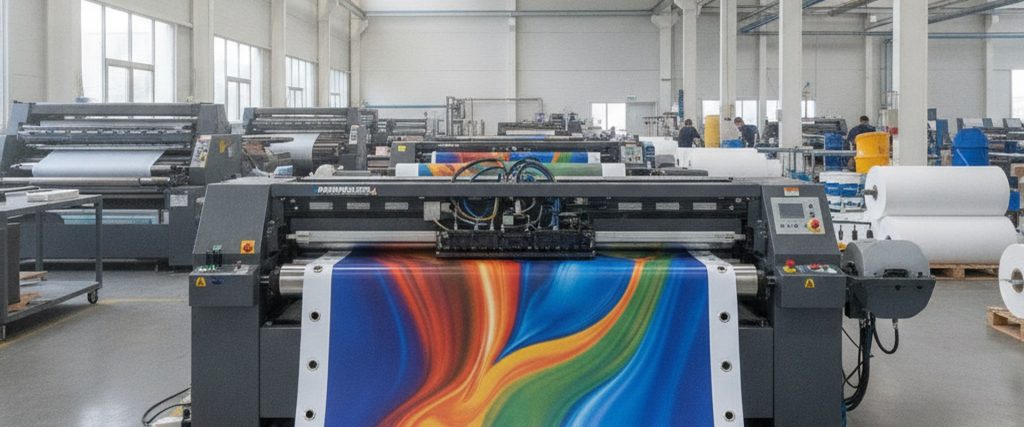
A banner lasts 2-3 years outdoors if it is printed on fabric of 440 g/m² or denser with UV-resistant inks and the sheet is reinforced with a glued pocket and grommets spaced 30-50 cm apart. A mistake in any of these three parameters and the banner sags or fades within a single season. Below: how to choose the banner fabric, the printing technology and the mounting method for your specific task: a store facade, a construction site fence, a promo stand or a press wall.
What Wide-Format Printing Is and Where It Is Used
Wide-format printing is the application of an image to roll materials 1.5 to 5 meters wide on a plotter. In outdoor advertising in Tashkent, this method is used to print banners, building-end wall banners, facade mesh, window and vehicle stickers, and posters for lightboxes and roll-ups. A single print pass gives a seamless sheet up to 3.2 m wide; larger surfaces are assembled by RF welding or cold gluing with a 3-5 cm overlap.
A banner solves three tasks: temporary advertising (a promotion, a sale, an announcement), a long-term banner sign and technical covering (facade mesh during renovation). Each needs its own material and technology; there is no universal "just a banner".
Types of Banner Fabric
Banner fabric is a PVC sheet on a polyester mesh base. It differs by density (g/m²) and by the way the PVC is applied: cast fabric is stronger than laminated fabric of the same density, but more expensive. The key choice is light transmission: frontlit for reflected light, backlit for lightboxes lit from the inside.
| Fabric type | Density | Light | Where it is used |
|---|---|---|---|
| Frontlit (front-lit) | 340-510 g/m² | Reflected | Banners, facades, fences, promo |
| Backlit (translucent) | 440-680 g/m² | Lit from the inside | Lightboxes, illuminated boxes |
| Mesh (net) | 270-370 g/m² | Reflected | Facades of high-rise buildings, wind-exposed structures |
| Blockout (double-sided) | 440-650 g/m² | Opaque | Double-sided banners, overhead street banners |
Perforated mesh lets 30-40% of the wind through, so it is hung on large facades: the wind load is reduced and the banner does not tear out its fixings. For a double-sided image, take blockout with a light-blocking black layer inside: the reverse image does not show through it.
Printing Technologies and Inks
The ink type determines fade resistance, odor and price. For outdoor use in Tashkent, with its intense sun and summer temperatures up to +42 °C, the UV resistance of the pigment is what matters most.
| Technology | Resolution | Outdoor durability | Features |
|---|---|---|---|
| Eco-solvent | 720–1440 dpi | 2-3 years | Almost odorless, suitable for interiors |
| Solvent | 360–720 dpi | 3-5 years | Strong odor, for outdoor use only, cheap in volume |
| UV (ultraviolet) | up to 1440 dpi | 3-5 years | Instant drying, printing on rigid materials |
| Latex | up to 1200 dpi | 3-5 years | Odorless, eco-friendly, rich color |
For a banner seen at close range (promo stand, press wall, interior), order from 720 dpi: the pixel is not visible from 1-2 meters. For a facade viewed from 20-50 meters, 360 dpi is enough: the layout is scaled anyway, and the print costs half as much. This is a standard way to save on large runs.
Grommets, Pockets and Sheet Reinforcement
A sagging or torn-off banner is almost always the result of skimping on edge finishing. Proper post-processing includes three elements:
- Glued pocket 5-10 cm wide around the perimeter: the sheet is folded over and RF-welded, so the edge does not delaminate.
- Grommets are metal rings 10-12 mm in diameter, set 30-50 cm apart. The stronger the wind, the closer together they are placed.
- Corner reinforcement is double gluing or a nylon tape inside the pocket for large-area banners.
For facade structures, a closed pocket for a pipe or cable is sometimes made instead of grommets: this way the load is spread along the whole edge instead of being concentrated on the rings. Tell us the mounting method before printing: the cutting layout and allowances depend on it.
How to Choose a Banner for the Task
A short selection guide. Promotion for 1-2 months needs frontlit 340 g/m², solvent 360 dpi and grommets around the perimeter. Banner sign for 2-3 years needs frontlit 440-510 g/m², latex or UV and a reinforced pocket. Large facade calls for mesh 270-370 g/m² for wind permeability. Lightbox needs backlit only, otherwise the backlight will show up as patches. Interior press wall or promo calls for eco-solvent or latex from 720 dpi for quality at close range.
If the task is broader than a banner, for example you need a rigid structure or a mobile stand, take a look at related solutions: roll-ups and mobile stands for exhibitions and presentations, or rigid outdoor advertising materials (composite, PVC, acrylic) for signs. For facade placement, it is important to take into account the rules for approving facade advertising in Tashkent.
Runs, Lead Times and Installation in Tashkent
Printing a standard 3×6 m banner takes from 1 working day in production. On volumes from 50 m², the cost per square meter drops by 20-30% thanks to cutting from whole pieces and a single press setup. Installation on a facade up to a height of 3-4 m is done by hand; higher up, with an aerial lift or industrial climbing; plan the approval of high-altitude work separately.
Before printing, check the layout: CMYK color profile, images of 72 dpi or more at real size for a facade and 150 dpi or more for an interior, 5-10 cm bleeds for the pocket, all text converted to outlines. The finished file is an uncompressed TIFF or PDF.
Frequently Asked Questions About Banners and Wide-Format Printing
How long does a banner last outdoors?
Frontlit fabric of 440 g/m² with latex or UV printing keeps its color and strength for 2-3 years in the Tashkent sun. Solvent printing on dense fabric lasts up to 5 years. A cheap 200 g/m² banner fades within a single season.
How is frontlit different from backlit?
Frontlit is designed for reflected light and is hung on walls and fences. Backlit is denser and designed for lighting from the inside, so it goes only into lightboxes; on a wall, backlit looks darker and costs more for no reason.
Why does a banner need perforation (mesh)?
A mesh banner lets 30-40% of the wind through, reducing the load on the fixings and the frame. It is a must for large facades of high-rise buildings, where a solid sheet acts as a sail and tears the structure apart.
What print resolution should I choose?
For a facade viewed from 20+ meters, 360 dpi is enough, and it is cheaper. For a promo stand, press wall and interior, where people look from 1-2 meters, order from 720 dpi, otherwise the raster dot is visible.
What is the grommet spacing?
The standard is every 30-50 cm around the perimeter, with a ring diameter of 10-12 mm and a mandatory glued pocket. For windy places the spacing is reduced to 25-30 cm and the corners are reinforced.
Can a double-sided banner be printed?
Yes, blockout is used for this: fabric with a light-blocking inner layer. It stops the reverse image from showing through, so both sides read clearly.
Order Banners and Wide-Format Printing in Tashkent
Aesthetic Pro prints banners, facade mesh and posters on wide-format plotters in Tashkent: we choose the fabric and technology for the task, finish the edge with reinforcement and install turnkey. Send us the size, the required service life and the placement, and we will calculate the material, the resolution and the run.
A mobile backdrop for photo zones and presentations is a press wall (brand wall), the same wide-format print as a banner, but on a collapsible frame.
We will make it to fit your task: order turnkey outdoor advertising with a cost and lead-time estimate.