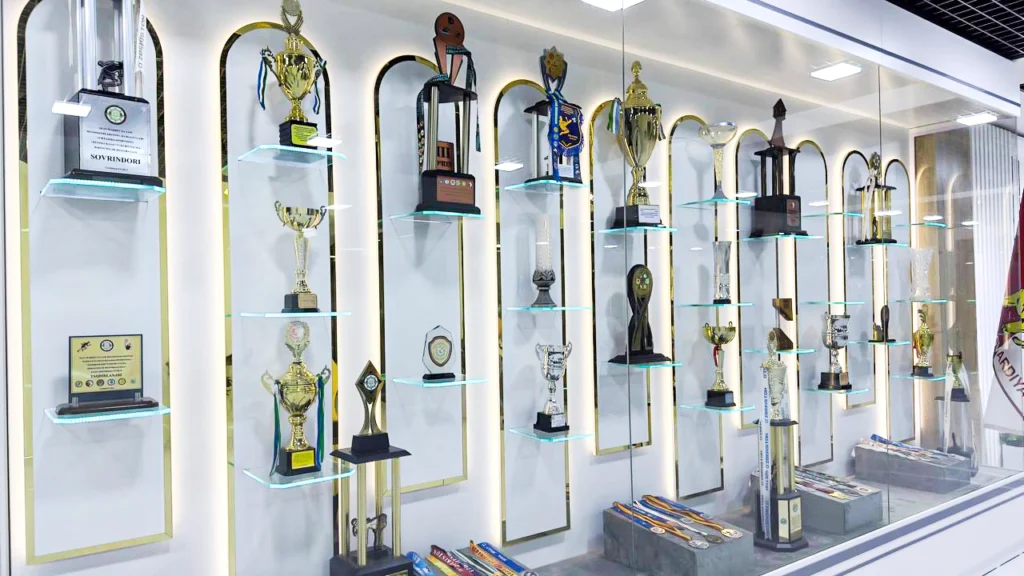
A corporate museum lets a company show guests, delegations and new employees its history, products and awards in one place. It can take up a hall, a room or a wall in the lobby, and when space is short it becomes a traveling exhibition or a digital project. Work starts with collecting the archive and the stories of people, and then the format and equipment are chosen.
What tasks a corporate museum solves
The first task is external: to receive guests and delegations so that the history of the company is visible without retelling. A partner who has walked through a hall with products, awards and a timeline understands the scale of the business before negotiations begin.
The second task is internal. New employees learn where the company came from, and HR includes a museum visit in the first week of onboarding. Veterans see their contribution on the history wall. For the brand the museum works as a permanent backdrop: mission and values become objects and photographs. Certificates, patents and awards that used to lie in drawers move into display cases where people can see them.
Where to start: archive, objects, documents and people
Work starts with an inventory of what already exists: photographs, orders, newspaper clippings, promotional materials, early product samples, tools, uniforms, stamps, old signs. Each object gets a card with its name, date, origin, storage location and condition.
There is also a reason to start early. Archives get lost during moves, renovations and changes of management, and the people who remember the first years retire. A museum records facts while they can still be checked.
Documents are needed to verify facts. The founding date, former names and the names of managers are checked against orders and constituent papers, otherwise a legend reaches the hall that the first veteran will refute.
Interviews with veterans are recorded while the people are available, on audio or video. Stories of two to three minutes fit into the multimedia and give the museum a living voice. For photos and videos of employees, written consent to display them is obtained.
If there are almost no objects, the project is still possible. The museum is built on photographs, documents and reconstructions, and what is missing is shown with models and graphics.
A small part of what is found reaches the hall, and the rest stays in storage. Three questions are used for selection: does the object tell a story, is it well preserved, and is it clear to someone who never worked at the company. An object a guest looks at for three seconds gives way to one beside which the guest stops.
Corporate museum formats
The format is set by floor area, the number of guests and how often the museum is shown. The areas in the table are planning benchmarks, and exact figures come from measuring the room.
| Format | Floor area | What fits | Who it is for |
|---|---|---|---|
| Museum hall | from 60 m² | Timeline, display cases with products and awards, models, multimedia | Delegations, partners, tours |
| Museum room | 15-40 m² | 4-8 display cases, a history wall, one screen | Guests at negotiations, new employees |
| History wall in the lobby | 5-12 m of wall | A timeline strip, photos, 1-2 display cases, a screen | All visitors to the office |
| Traveling exhibition | 6-20 m² when assembled | Modular stands, tabletop display cases, a screen | Exhibitions, conferences, branches |
| Digital museum | A screen or a website, no floor area needed | Digitized archive, 3D models, veterans' videos | Remote employees, partners, online guests |
Formats can be combined. A museum room in the head office and a traveling exhibition for branches use the same materials, and a digital version preserves the archive when some objects cannot be put on display.
A visit scenario is chosen to fit the format. Delegations with limited time follow a short route through key points: the founding, the product, the awards. School groups and employees walk longer and stop at the screens. The route is drawn so that a visitor can leave it at any point, and the start and the end are visible without signs.
What to put into the exhibition
Display cases for awards and products
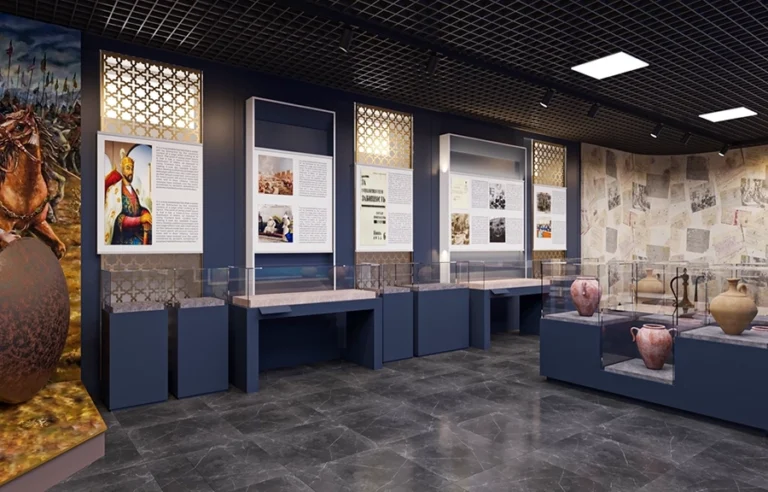
Awards, cups and product samples are gathered in display cases and stands. A tabletop case 90-120 cm high shows small objects at eye level, a floor-standing case up to 200 cm opens a piece from every side, and a wall case 8-20 cm deep suits diplomas and documents. Documents and textiles are lit up to 50 lux and metal and stone up to 300 lux, and certificates and cups are better placed in separate cases.
For awards and valuable samples the glazing is made of 6-10 mm tempered or laminated glass, and the case is fixed to the floor and locked. The lighting uses LEDs with a CRI of 90 or higher and no ultraviolet, so the shine of metal and the color of enamel look as they do on the original.
Timeline and models
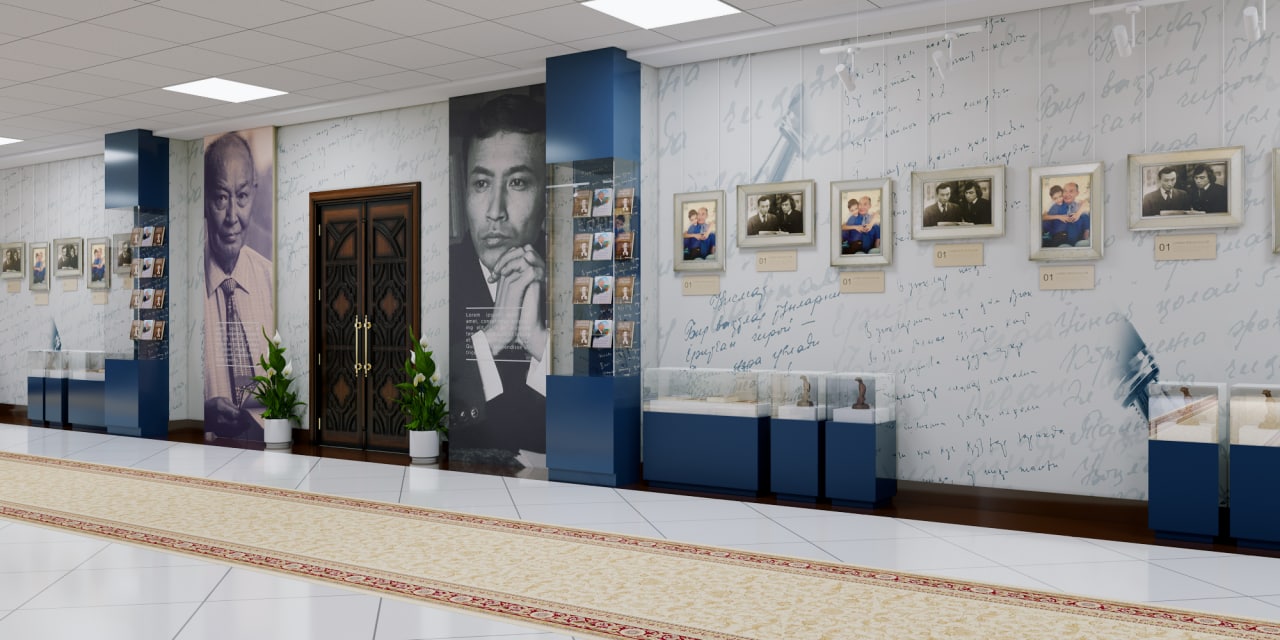
The timeline runs along a wall: years, key events, photos. The caption font is chosen for the viewing distance, and only dates confirmed by documents are displayed. Scale models of a plant, a building or a product show what cannot be brought into the hall. The podium under a model is calculated for a load of 150 kg/m² or more.
Multimedia
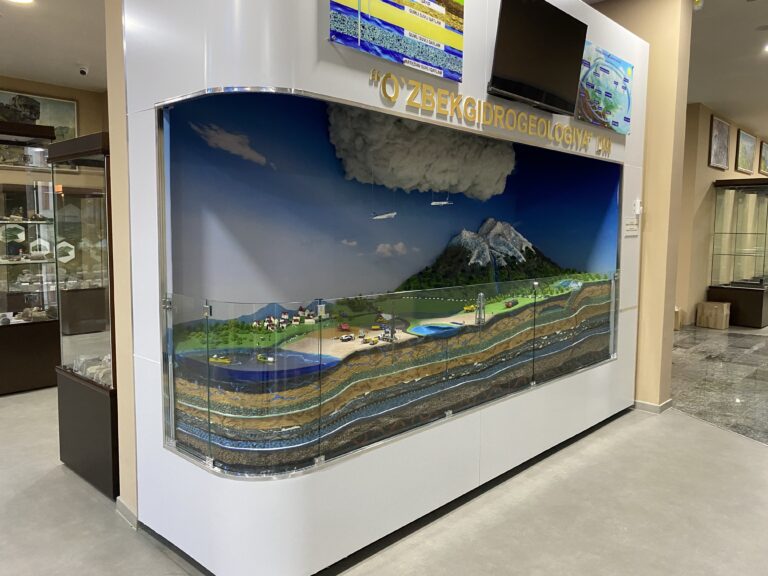
A 32-65 inch touch panel on vandal-resistant glass holds the product catalog, the photo archive and the interviews with veterans. Projection onto a model brings a production scheme to life. An archive on a screen holds more than display cases do, takes no wall space and is updated without rebuilding the hall.
Next to the touch panel a multimedia guide is placed: a guest scans a QR code on a phone or takes a tablet and listens to the story of an object in their own language. Such a guide replaces long captions and gives staff time for live conversation with a delegation.
Texts in the museum are short. A caption for an object fits into a few lines with the name, the date and one sentence on why the object is there. The details move to a screen for those who want to read more. All texts are prepared in Russian, Uzbek and English, and the length of the translation is built into the layout from the start.
The general order of work, from concept to installation, is described in the article on how to create a museum. For a corporate museum it is the same, and only the set of materials and the number of approvers change.
How to keep the museum alive
A museum to which nothing is added turns into a storeroom of old things. The timeline is updated once a year with new awards, projects and products. Replaceable panels and free display cases are left in the exhibition so that new items appear without rebuilding the hall.
Paper documents and photographs cannot stay in the light for years. They are rotated, a copy is shown in the case and the original goes to archival storage.
Tours are led by a designated employee following a script in Russian, Uzbek and English. The museum also works as a venue for events: a founding day, receptions for delegations, meetings with veterans, visits by school groups. Content on the screens is updated on a schedule, and lamps and screens with a limited service life are replaced before they go dark in front of guests.
A museum's results are easy to measure: how many groups came through in a quarter, which guests the museum brought in, how many new employees saw it in their first week. Guest feedback and the questions visitors ask at the cases show which sections need strengthening.
The museum and the sign at the entrance form a single system: a pointer, a plaque by the hall door and an inscription on the wall set the tone before the first display case. Graphics and wayfinding follow the company style, with the same fonts and colors as in catalogs and on the website.
What to decide before ordering
You need a person responsible on the company side: someone who collects the archive, approves the texts and accepts the work. Without such a person the project stands still while every comment looks for an addressee. Dates matter too: if a delegation arrives on a certain day, design, production and installation are counted backward from it. For a compact exhibition the benchmark starts at 4 weeks, and for a museum hall with multimedia and custom lighting it is 8-10 weeks, with the concept and the archive collection not included.
The budget is divided into three parts: equipment and installation, content, and upkeep. Content, meaning filming, digitizing the archive, texts and translations, is underestimated most often, although it takes no less time than producing the display cases. Upkeep is set aside as a separate line that covers replacing lamps, updating screens and rotating documents.
Aesthetic Pro takes on the equipment and installation of a corporate museum in Tashkent: display cases, a timeline on the wall, models, screens and lighting. The format and the content of the exhibition are chosen to fit your floor area, and the details are on the corporate museum.
Frequently asked questions
Why does a company need a corporate museum?
A museum shows history, products and awards to guests and delegations, helps new employees get oriented and keeps the archive in one place. For the brand it works as a permanent exhibition that needs no presentation.
How much space does a corporate museum need?
A museum room needs 15-40 m², and a full hall with display cases and multimedia needs from 60 m². If there is no space, a history wall 5-12 m long in the lobby or a traveling exhibition of 6-20 m² is made.
What if the company has kept almost no objects?
The museum is built on photographs, documents, and audio and video interviews. What is missing is shown with models, graphics and multimedia, and the history is confirmed by documents.
How long does it take to create a corporate museum?
Design, production and installation take from 4 weeks for a compact exhibition and 8-10 weeks for a hall with multimedia and custom lighting. Collecting the archive and writing the texts are separate.
Can documents and awards be shown in one display case?
It is better to separate them because paper and textiles allow up to 50 lux, metal and stone up to 300 lux. In a separate case for each group the light is set to suit the material.
How do you update a corporate museum?
The timeline is updated once a year, content on the screens is changed on a schedule, and light-sensitive documents are rotated. Replaceable panels and free display cases let you add new items without rebuilding the hall.
Related services
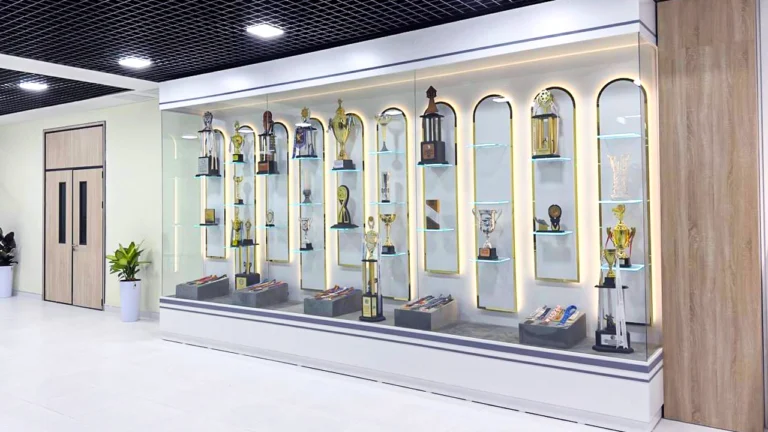
Corporate museum
A company history museum: hall, award cases, timeline and multimedia.
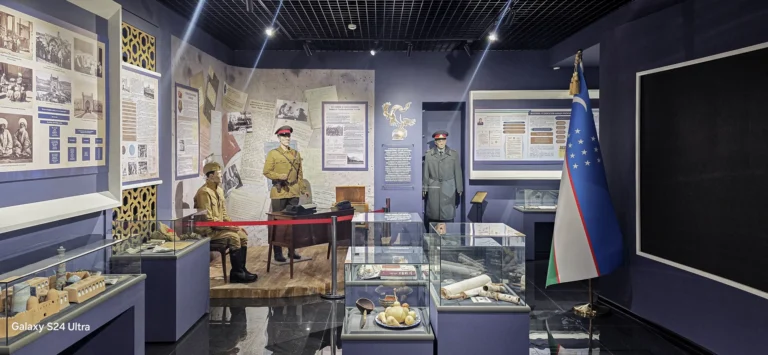
Museum creation
Museum concept, design, display cases, lighting, multimedia and installation in a single project.