

A lightbox is an illuminated box with internal lighting that works as a round-the-clock sign or advertising medium. In Tashkent such structures are found on the facades of cafes, petrol stations and pharmacies, in shopping centers and at bus stops. Below we look at the construction, lighting types, formats and real production prices in Uzbekistan.
What a lightbox is and where it is used
A lightbox is a three-dimensional box (more often rectangular, less often shaped) with a transparent or translucent front panel, inside which a light source is placed. The lit image or logo is visible by day, at night and in overcast weather. Hence the main job of the structure: to ensure contrast and legibility of the brand 24/7.
In Tashkent lightboxes are widely installed on the facades of restaurants and cafes, pharmacies, banks, petrol stations, car washes, and at the entrances of shopping centers and business centers. Light posters, built into public transport stops and food courts, are a separate popular format. We described in more detail how lightboxes fit into the overall exterior design in our article on facade advertising in Tashkent.
Lightbox construction: structure and materials
A standard light box consists of four elements: a frame, side walls (returns), a front light-transmitting panel and a lighting system with a power supply. The frame is assembled from aluminum profile with a section of 80-150 mm, which sets the depth of the box. The larger the area of the front panel, the deeper the box, otherwise the lighting will show blotches.
The returns are made of galvanised steel with powder coating or of the same aluminum profile. The back wall is composite or galvanised sheet 0.5-0.7 mm thick. Inside, LED strip or modules are mounted, the wiring is laid and a 12 or 24 volt power supply is installed. The front panel is fixed with snap clips or a clamping profile, which allows it to be removed to replace the image or repair the lighting.
| Tip When designing a box less than 80 mm deep, use edge-lit LED lighting with a diffuser sheet, otherwise bright dots from the modules will be visible on the front panel. |
Types of lightboxes by lighting type
The choice of lighting determines the brightness, power consumption, service life and total cost of ownership. Today the market offers three workable options, each with its own niche.
LED lighting
LED modules have been the main standard for lightboxes since 2015. The life of quality modules is 50,000-70,000 hours (8-12 years of operation at 16 hours a day). Power consumption is 80-120 W/m² of front panel. The light is even and flicker-free, and the spectrum stays stable throughout the service life.
Fluorescent lamps
T5 and T8 tubes are a fading technology that is still found. Life is 10,000-15,000 hours (1.5-2.5 years), power consumption 150-200 W/m². They are sensitive to voltage fluctuations; on Uzbek grids in residential areas, lamp-based boxes break within a season. Today they only make sense for urgent replacement in an existing structure built for the old mounting.
OLED panels and light sheets
OLED and electroluminescent films give uniform illumination of the whole area without dots, and the box thickness is reduced to 10-20 mm. The cost is 4-6 times higher than LED, and the life is so far 25,000-35,000 hours. Used for premium interior signs in boutiques, bars and showrooms.
| Lighting type | Life, hours | Consumption, W/m² | Cost per m² |
| LED modules | 50 000–70 000 | 80–120 | $180–$350 |
| Fluorescent T5/T8 | 10 000–15 000 | 150–200 | $120–$180 |
| OLED / EL film | 25 000–35 000 | 40–70 | $600–$1200 |
Types by shape and installation
By design, lightboxes divide into several typical formats, chosen to suit the facade architecture and the brand's goals.
Flat facade
Fixed parallel to the wall, single-sided. Dimensions from 0.5 × 0.5 m to 12 × 2 m and larger. Depth 80-200 mm. The most widespread option for cafes, shops and offices.
Projecting double-sided
They project perpendicular to the wall on a bracket and can be read along the street from two directions. Typical sizes 600 × 800 mm, 800 × 1200 mm. Used by pharmacies, banks, notaries and coffee shops on the narrow streets of the Old City.
Dimensional and shaped
The box follows the outline of a logo or figure. The face is formed acrylic, the side is bent aluminum. Used for branded signs of restaurants and petrol station chains.
Light posters
Thin boxes 25-40 mm deep with edge LED lighting and a replaceable poster inside. Standard formats are A1, A0, 1200 × 1800 mm. Installed in shopping centers, food courts, at bus stops and in business center lobbies.
Front panel materials: acrylic, flex-face banner, polycarbonate
The face of the box determines the appearance and service life of the structure in Tashkent's climate. There are three most common materials, each with its own use case. We covered the materials of outdoor structures in full in our article on materials for outdoor advertising.
Opal acrylic 3, 5 and 8 mm thick gives a soft, even glow and is considered the basic option for boxes up to 3 × 1.5 m. Colored Oracal film is applied to it, or an image is printed. Flex-face banner is PVC fabric stretched over the face, which makes it possible to build huge boxes up to 12 meters long without seams or joints. Cellular or solid polycarbonate is used where there is a risk of impact or vandalism, for example on the lower boxes of car washes and petrol stations.
| Face material | Light transmission | Impact resistance | Service life | Max. size without seam |
| Acrylic 3-8 mm | 70–80% | Medium | 10-12 years | 3 × 2 m |
| Flex-face banner | 55–65% | High (elastic) | 5-7 years | 12 × 3 m |
| Polycarbonate | 60–75% | Very high | 8-10 years | 2 × 3 m |
Where lightboxes pay off the most
A lightbox pays off where traffic flows around the clock or in the evening and competition for the customer's attention is high. On the lit streets of central Tashkent, a plain flat sign without lighting gets lost among its neighbors by 19:00, especially in winter.
| Site | Recommended format | Typical size |
| Cafe, restaurant | Flat facade + projecting | 2-4 × 0.8 m |
| Petrol station | Monument sign + 3D logo | from 4 × 6 m |
| Pharmacy | Double-sided projecting with a cross | 0.8 × 0.8 m |
| Boutique in a shopping center | Light poster or 3D letters in a box | 1.2 × 1.8 m |
| Car dealership | Large facade flex-face | from 6 × 2 m |
| Bank, notary | Projecting + flat facade | 1 × 1 m |
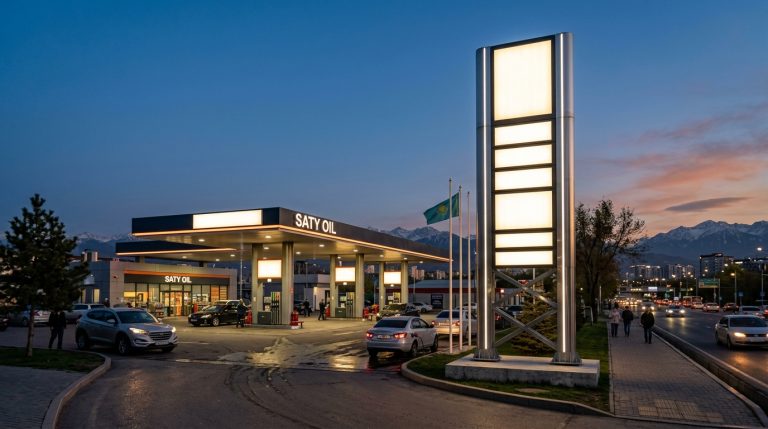
For example, for a coffee shop chain in central Tashkent the best pairing is a compact 600 × 800 mm projecting box above the entrance and a flat 3 × 0.6 m facade box above the shop window. For a petrol station in Chilanzar the standard is a pylon-type monument sign with an illuminated logo 4-6 meters high, visible from the carriageway at 200-300 m.
Service life and maintenance in Uzbekistan's conditions
Tashkent's climate: summer +42 to +45°C, winter -5 to -10°C, dust, rare but heavy precipitation. This hits electronics and materials harder than in temperate zones. For more on the factors behind the durability of advertising structures, see our overview of the service life of outdoor advertising.
| Tip Use LED modules with IP65 protection and power supplies with a 20-30% power reserve. Summer heat of up to +45°C cuts the life of ordinary LEDs almost in half and kills cheap drivers within a season. |
Real service lives in our conditions: an aluminum frame lasts 15+ years without corrosion, an acrylic face 10-12 years before yellowing, a flex-face banner 5-7 years before fading and sagging, and IP65 LEDs 8-10 years of operation. Maintenance comes down to washing the front panel twice a year (after winter and in midsummer) and checking the fixings after strong winds. On choosing between a lightbox and a neon sign, see our article on LED and neon signs.
How much does a lightbox cost in Tashkent
The price is calculated per square meter of front panel, including lighting, standard installation and commissioning. The final cost depends on the size, the face material, the type of lighting, the complexity of installation and the number of faces (single- or double-sided).
| Category | Lighting / face | Price per m² |
| Budget | Economy LED + 3 mm acrylic | $150–$220 |
| Standard | LED IP65 + 5 mm acrylic with film | $230–$350 |
| Large format | LED IP65 + flex-face banner | $180–$280 |
| Premium | LED RGB + polycarbonate + dimensional elements | $400–$600 |
Aesthetic Pro makes lightboxes in its own workshop in Tashkent, from projecting boxes for coffee shops to facade structures 10-12 meters long for shopping centers and car dealerships. The warranty is 5 years on the frame and 2-3 years on the LED lighting, depending on the type of modules. Design, approval from the khokimiyat (city administration), production and installation under one contract.
FAQ
How much electricity does a 4 × 1 meter facade lightbox use?
With LED lighting at 100 W/m², a 4 m² box uses about 400 W. Over a month of continuous operation at 12 hours a day that is about 144 kWh, roughly 90-110 thousand UZS at the business tariff in Tashkent.
Can a lightbox be installed without approval?
No. Any outdoor sign in Tashkent requires approval from the district khokimiyat and the architecture service. Without an advertising structure passport you risk a fine and forced dismantling. We take care of preparing the documents.
What to choose: acrylic or flex-face banner?
Acrylic wins on service life and image quality and is best up to 3 × 2 meters. Flex-face banner is cheaper per area and allows huge seamless structures, the choice for long facades from 4 meters.
How long does it take to make a lightbox?
A standard box up to 6 m²: 7-10 working days from approval of the layout. Large formats and shaped structures with dimensional elements: 14-21 days. Khokimiyat approval runs in parallel and takes 10-20 days.
What breaks most often in a box?
In first place are LED power supplies during voltage swings in the grid, in second place yellowing or sagging of the front panel when money is saved on the material. The aluminum frame itself lasts for decades. So do not economise on the drivers and the voltage stabilizer in the estimate.
Can an old fluorescent box be converted to LED?
Yes. The frame and face are usually kept and the insides are replaced: lamp holders and tubes are removed, and LED modules, a new power supply and wiring are installed. The cost of conversion is 30-45% of the price of a new box of the same size.
If you are planning a lightbox for your site in Tashkent, send us a photo of the facade, the size you want and your logo. We will select the format, material and lighting to fit your budget, and calculate the estimate and lead times within one working day.
If the image has to be changed often, a lightweight alternative to a light box is poster frames and click frames with a replaceable poster in 30 seconds.
We will make it to fit your task: order turnkey outdoor advertising with a cost and lead-time estimate.