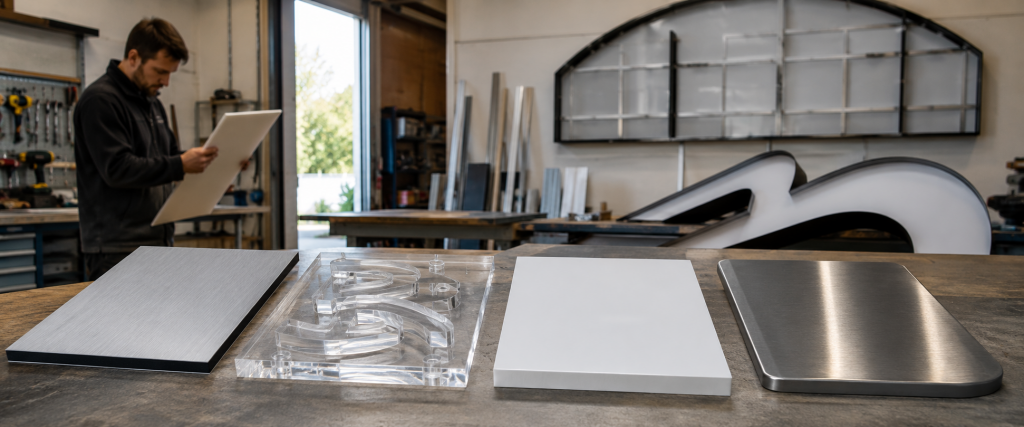
Choosing the material is the first and most important decision when ordering outdoor advertising. The material determines how a sign will look after one year, three years and ten years. Cheap plastic will fade within a season, while quality composite will stand for a decade. Stainless steel needs no maintenance, while a banner needs replacing every couple of years.
In this article we compare four main groups of materials for outdoor advertising: composite panels, acrylic, PVC and metal. We go through the pros and cons of each, give real service lives in Uzbekistan's climate and help you choose the best option for a specific type of structure.
Aluminum composite panels (alyukobond): the basis of outdoor advertising
An aluminum composite panel is a "sandwich" of two thin aluminum sheets with a polymer core between them. Trade names: Alyukobond, Dibond, Goldstar, Alucobest. It is the most widely used material for sign backing panels, facade structures and monument signs.
Advantages of composite
- Lightness: a 4 mm panel weighs 5.5 kg/m², 3 times lighter than an aluminum sheet of comparable rigidity. This simplifies installation and reduces the load on the facade.
- Rigidity: the panel does not sag, does not vibrate in the wind and stays flat over large areas (up to 3×1.5 m without an additional frame).
- Weather resistance: quality composite does not delaminate or warp and is resistant to UV radiation. The factory finish (PVDF coating) keeps its color for 15-20 years.
- Workability: easy to cut, mill and bend on a press brake. Ideal for complex shapes and dimensional structures.
- Affordable price: one of the most budget-friendly materials for outdoor advertising, yet with high performance characteristics.
Limitations
- Not translucent, so it is not suitable for the face panels of illuminated signs (acrylic is needed).
- Composite with a polyethylene (PE) core is flammable. For high-rise buildings and sites with heightened fire-safety requirements, composite with a mineral core (FR) is used.
Where it is used
Sign backing panels (text applied as film or dimensional letters), facade panels, cladding for monument signs and pylons, wayfinding plaques, information boards. Composite is the "workhorse" of outdoor advertising, accounting for up to 60% of all structures.
Acrylic (plexiglass): for illuminated structures and dimensional letters
Acrylic (polymethyl methacrylate, plexiglass, Plexiglas) is a transparent or translucent material, the main choice for the face panels of illuminated signs, dimensional letters and lightboxes. It transmits up to 92% of light, more than ordinary glass.
Advantages of acrylic
- Light transmission: milky acrylic spreads the light of LED modules evenly, with no "hot spots" or dark zones.
- Color range: acrylic comes in dozens of colors, including fluorescent and translucent ones. The color does not fade for 8-12 years.
- Processing: easily cut by laser and router, thermoformed (bent when heated) and polished to a mirror shine.
- Durability: does not yellow from UV (quality grades) and does not crack with temperature swings from −30 to +80 °C.
- Impact resistance: 10 times stronger than ordinary glass at the same weight.
Limitations
- It scratches more easily than glass, so it needs care during transport and installation.
- More expensive than PVC; for non-illuminated structures acrylic is not always economically justified.
- Budget acrylic (GPPS, polystyrene marked as "plexiglass") yellows after 2-3 years, so use only PMMA (genuine acrylic).
Where it is used
Face panels of dimensional letters, lightbox face panels, indoor signs, decorative elements, stands and displays. In outdoor advertising, acrylic is the second most popular material after composite.
PVC (polyvinyl chloride): light and affordable
PVC is used in outdoor advertising in two forms: foamed (Forex, Simona), lightweight sheets 3-10 mm thick, and rigid, dense sheets for structures with higher loads. It is the most budget-friendly advertising plastic.
Advantages of PVC
- Low price: 2-3 times cheaper than acrylic and composite per square meter.
- Lightness: 5 mm foamed PVC weighs 3 kg/m², ideal for temporary structures and indoor plaques.
- Processing: can be cut with a utility knife, milled, glued and painted easily.
- Moisture resistance: does not absorb water or rot, so it suits damp rooms.
- Wide palette: white, colored, with UV printing directly onto the surface.
Limitations
- Heat deformation: above +60 °C, foamed PVC starts to warp. In Tashkent a south-facing facade heats up to +65-70 °C, and PVC on it deforms within 1-2 summers.
- Brittleness in frost: at −10 °C and below, foamed PVC becomes brittle and can crack on impact.
- Fading: without protective lamination, PVC print fades within 6-12 months outdoors.
Where it is used
Indoor signs and plaques, temporary outdoor structures (for 1-2 seasons), exhibition stands, POS materials (shelf talkers, price tag holders, displays), non-illuminated dimensional letters for interiors. PVC is not recommended for permanent outdoor advertising: choose composite or acrylic.
| PVC or composite: which to choose? If the structure will stand outdoors for more than 1 year, choose composite. If it is for an interior, an exhibition or a temporary promotion, choose PVC. If you need an illuminated panel, neither: acrylic. |
Metal: stainless steel, aluminum, galvanized steel
In outdoor advertising, metal is used for structure frames and for standalone advertising elements (letters, decor, pylons). Three main types of metal serve different tasks.
Stainless steel
A premium material for letters, logos and decorative elements. Finish options: mirror polish, matte brushing, and bronze, gold and copper effect coatings (PVD coating). Stainless steel does not rust, fade or deform, with a service life of 20+ years without maintenance. It is the most expensive of all advertising materials.
Applications: dimensional letters for banks, hotels and premium brands; decorative panels on facades; elements of pylons and monument signs.
Aluminum
Lightweight, corrosion-resistant and takes powder coating well. Aluminum profile is used for lightbox frames, the sides of dimensional letters and frame structures. Aluminum is 2.5 times lighter than steel, which is critical for large rooftop and facade structures. Service life is 15-20 years.
Galvanized steel
A frame material for monument signs, pylons, banner frames and rooftop structures. Galvanizing protects against corrosion for 10-15 years. Additional powder coating extends protection by another 5-7 years. It is the working frame material to which composite or acrylic cladding is attached.
Material comparison table
| Parameter | Composite | Acrylic | PVC | Metal |
| Service life | 10-15 years | 8-12 years | 1-5 years (outdoors) | 15-25 years |
| Cost | Medium | Above medium | Low | High |
| Weight (4 mm) | 5.5 kg/m² | 4.8 kg/m² | 3 kg/m² | 8-30 kg/m² |
| Light transmission | No | Up to 92% | No | No |
| UV resistance | High | High | Low | Maximum |
| Heat resistance | Up to +80 °C | Up to +80 °C | Up to +60 °C | > +100 °C |
| Processing | Milling, bending | Laser, milling | Knife, milling | Welding, bending |
| Best use | Backing panels, monument signs, pylons | Illuminated letters, lightboxes | Interior, POS, temporary | Frames, premium letters |
Additional materials: films, banner fabric, polycarbonate
Self-adhesive films
Film is not a structural material in its own right, but no sign is complete without it. It is applied to composite, acrylic, PVC or metal to create lettering, images and color fields. Key brands: Oracal (series 641, 751, 951), 3M (series 1080, IJ180), Avery Dennison. The choice of series determines the service life of the graphics: from 1 year (calendered) to 8 years (cast with lamination).
Banner fabric
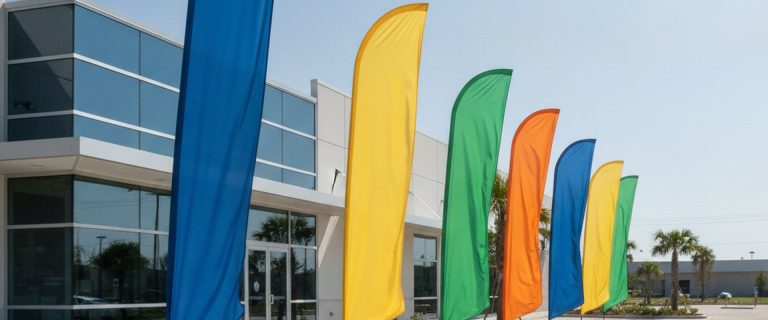
Vinyl fabric with a reinforcing mesh for large-format printing. Density from 300 to 550 g/m². The denser it is, the longer it lasts and the better it holds tension. For Uzbekistan, a density of 440 g/m² or more with lamination is recommended. Service life is 1-3 years. Applications: temporary banners, construction mesh, stretched street banners.
Polycarbonate
An alternative to acrylic for vandal-resistant structures. Polycarbonate is 200 times stronger than glass and does not shatter on impact, so it is used for ground-floor signs, bus shelters and advertising structures in places with a high risk of damage. The downside is that it transmits light less well (85% vs 92% for acrylic) and costs more.
How to choose a material: an algorithm by structure type
The choice of material depends on the type of advertising structure and operating conditions. Use a simple algorithm:
- Flat facade sign: composite panel + self-adhesive film (cast for the south, polymeric for the north).
- Illuminated dimensional letters: acrylic (face) + aluminum or galvanized steel (sides) + LED modules.
- Lightbox: aluminum profile (frame) + acrylic (face panel) + banner fabric or film (image).
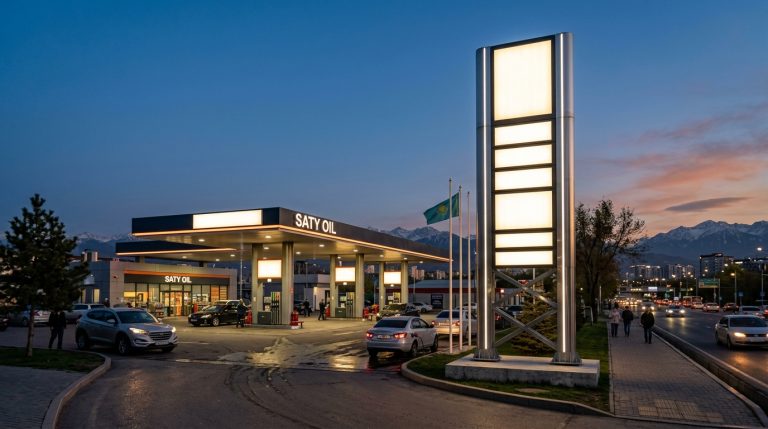
- Monument sign / pylon: galvanized frame + composite cladding + acrylic light panel (if illuminated).
- Temporary promotion (1-3 months): PVC + UV printing or banner fabric.
- Indoor sign: PVC, acrylic or stainless steel, depending on budget and style.
- Premium sign: stainless steel (letters) + composite (backing) + LED (halo backlighting).
Frequently asked questions
Which material is best for a store sign?
For most stores, the best option is composite as a backing panel plus acrylic dimensional letters with LED lighting. It is reliable, eye-catching and affordable. If the budget is limited, use a composite panel with film graphics (without dimensional letters).
Can PVC be used for an outdoor sign?
Yes, but only for temporary structures (up to 1 year). PVC is not suitable for permanent outdoor advertising: it deforms in the heat and fades. The exception is rigid PVC in structures protected by a canopy or awning.
What is the difference between 3 mm and 4 mm composite?
A thickness of 3 mm suits small signs (up to 1 m²) and indoor plaques. For facade structures of 1 m² and more, the standard is 4 mm: it is stiffer, does not sag in the wind and holds fixings better. The price difference is about 15-20%.
How can you tell quality acrylic from a fake?
Genuine acrylic (PMMA) is marked by the manufacturer: Plexiglas, Acrylite, Altuglas. The protective film shows the brand and thickness. Polystyrene (GPPS) fakes are cheaper but yellow after 2-3 years and crack in frost. A simple test: when burned, acrylic smells fruity and polystyrene smells acrid.
Which material is the most economical in the long term?
Composite for backing panels (10-15 years without replacement) and stainless steel for letters (20+ years). Expensive at the start, they need no replacement or repair for years. Budget materials (PVC, banner) are cheaper upfront but cost more per year of use because of frequent replacement.
Where can I buy outdoor advertising materials in Tashkent?
Advertising and production agencies buy materials wholesale from trusted suppliers and include them in the project price. When you order a sign turnkey, you get a guarantee on material quality. Buying on your own makes sense only if you have your own production.
Order outdoor advertising made of quality materials from Aesthetic Pro
Aesthetic Pro works only with proven materials: 4 mm composite with PVDF coating, PMMA acrylic, AISI 304 stainless steel, Samsung and Seoul Semiconductor LEDs, Oracal 751/951 films. We do not cut corners on components: every structure is designed for the maximum service life in Uzbekistan's climate.
For printing on flexible substrates, banner fabric, mesh and film, see the separate overview: banners and large-format printing.
We will make it to fit your task: sign and outdoor advertising production with a cost and lead-time estimate.