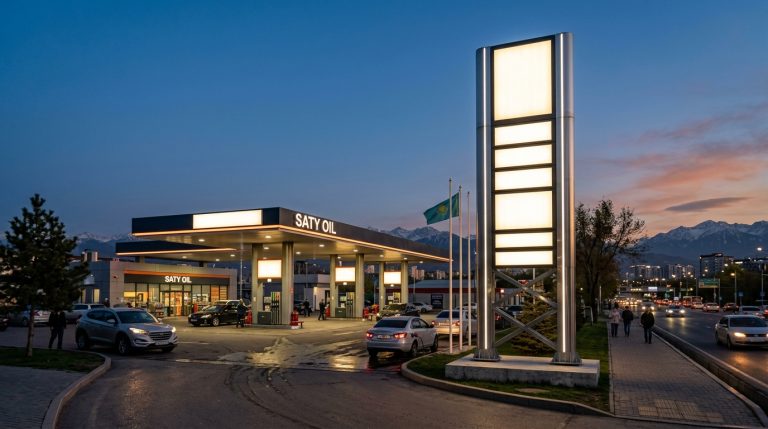


A pylon is a freestanding vertical advertising or wayfinding structure that greets visitors at the entrance to a site. For business centers and residential complexes, a pylon does two jobs at once: it identifies the site and helps people find their way around the grounds. Tenants find the right office, residents their building and entrance, guests the parking lot and reception.
In Tashkent the number of modern business centers and residential complexes grows every year, and demand for quality wayfinding systems grows with it. Pylons have become the standard for developers, management companies and landlords who care about visitor comfort and the image of the property.
Why a business center or residential complex needs a pylon
A pylon solves problems that facade signs and wall-mounted directional signs cannot. A facade sign is visible from a limited angle, only when the visitor is already standing in front of the building. A pylon works at a distance: it can be seen from the approach road, from the junction and from a passing car.
The main tasks of a pylon:
- Site identification: the name of the business center or residential complex, the developer's logo. A visitor on the road understands they have arrived at the right address.
- Wayfinding around the grounds: directions to buildings, entrances, parking lots, reception and service areas.
- Tenant information: in business centers a pylon can carry a list of companies with floors and offices.
- Image and status: a quality pylon signals a high-class property. For premium residential complexes and Class A business centers it is a must-have element.
- Night visibility: an illuminated pylon works around the clock, providing orientation after dark.
Types of pylons: classification by purpose and construction
Wayfinding pylons
A wayfinding pylon is the main type of structure for residential complexes and business centers with extensive grounds. Its job is to guide the visitor to the right point. Such a pylon carries directional arrows, building numbers and a site plan. Wayfinding pylons are installed at key points on the route: at the entrance to the grounds, at road forks, at building entrances and in the parking lot.
For large residential complexes with 5-10 buildings, a wayfinding system may include 8-15 pylons of different sizes: a large entrance pylon at the barrier, medium ones at internal road junctions, and compact ones at building entrances.
Information pylons
An information pylon carries detailed data: a list of business center tenants, a map of the residential complex, contact details of the management company, opening hours. Such pylons are installed directly at the building entrance, in the parking lot or in the lobby. They are designed for pedestrians who have already reached the site and are looking for specific information.
The key requirement for an information pylon is legibility. The font must be large enough, and the structure must be at eye level (the center of the information block 140-160 cm from the ground). If tenant lists are updated often, interchangeable panels or plaque slots are provided.
Advertising pylons
An advertising pylon is used to promote the site itself or its tenants. It is a larger and more prominent structure, 3-6 meters tall, often with full-color printing, LED lighting or an electronic screen. Advertising pylons are installed at the exit to a main road, at junctions and along approach roads, wherever maximum reach of passing traffic is needed.
For new developments and residential complexes at the sales stage, an advertising pylon is a powerful tool for attracting buyers. It carries visualizations of the complex, sales department contacts, promotions and purchase terms. After residents move in, the advertising pylon can be replaced with a wayfinding one or converted.
Entrance monument signs and human-scale pylons
An entrance monument sign is a large-format pylon 4-8 meters tall, installed at the main entrance to the grounds. It is the property's "business card", visible from 200-500 meters away. A monument sign usually carries only the name of the complex and a logo, without detailed information. Its job is to make an impression and mark the location.
Human-scale pylons are an intermediate format 2-3.5 meters tall, visible from 50-100 meters. They are often used as elements of a unified wayfinding system: beside each building stands a human-scale pylon with a number and arrows to the nearest infrastructure facilities.
Materials and design solutions
The choice of material determines the appearance, durability and cost of a pylon. Several main solutions are used in the production of advertising structures in Tashkent.
- Composite panels (alyukobond). The most common option for pylon cladding. Lightweight, weather-resistant and available in any RAL color. A profile tube frame is clad in composite, giving a neat, durable structure with a service life of 10-15 years.
- Stainless steel. A premium material for Class A pylons. Mirror polish, matte brushing or a bronze/gold finish create a sense of respectability. Stainless steel does not rust or fade, but costs 2-3 times more than composite.
- Galvanized steel with powder coating. A frame material that is painted in the brand color. Cheaper than stainless steel, but requires a quality coating to protect against corrosion. The best solution for wayfinding pylons on residential complex grounds.
- Acrylic and polycarbonate. Used for illuminated face panels. Milky acrylic gives an even glow with internal LED lighting. Polycarbonate is used for vandal-resistant structures; it is 200 times stronger than glass.
- Tempered glass. A design element for premium pylons: a glass insert with engraving, a transparent illuminated information panel. Glass needs careful handling during installation but looks striking.
Pylon lighting: what solutions are used
A pylon without lighting works only in the daytime, and therefore loses half of its effectiveness. For business centers and residential complexes, where people arrive in the evening too, lighting is a must.
- Internal LED lighting. LED modules are placed inside the body and the light passes through an acrylic or polycarbonate panel. It gives an even glow across the entire information surface. Power consumption is 20-60 W per pylon.
- Halo lighting. LED strip along the perimeter of the back panel creates a soft halo against the wall or landscape. It highlights the outline of the pylon and gives the structure depth. Popular in premium residential complexes.
- External spot lighting. Ground-mounted or wall-mounted floodlights are aimed at the pylon from outside. A simple, inexpensive solution for non-illuminated structures: two 10-20 W LED floodlights are enough.
- Combined lighting. A combination of several types in one structure: a light panel + halo lighting + illuminated dimensional letters. Maximum visual effect for flagship sites.
Cost of pylons in Tashkent
The price of a pylon is made up of design, materials, fabrication, foundation and installation. Below are approximate ranges for the Uzbekistan market.
| Pylon type | Approximate price | Lead time |
| Wayfinding pylon (h 1.5-2.5 m, composite) | from 4,500,000 UZS | 2-3 weeks |
| Information pylon (h 2-3 m, composite + acrylic) | from 6,000,000 UZS | 3-4 weeks |
| Advertising pylon with LED lighting (h 3-5 m) | from 12,000,000 UZS | 4-6 weeks |
| Entrance monument sign (h 5-8 m, metal + composite) | from 20,000,000 UZS | 5-8 weeks |
| Stainless steel pylon (h 2-3 m) | from 10,000,000 UZS | 4-6 weeks |
| Wayfinding set for a residential complex (5-10 pylons) | from 30,000,000 UZS | 6-10 weeks |
* Prices are approximate and depend on the specific project parameters, order volume and installation complexity.
Pylon installation: foundation, mounting, electrics
Installing a pylon is not just "putting the structure on the ground". Proper installation involves several engineering stages that determine stability, safety and service life.
Foundation
Any pylon 1.5 meters or taller needs a foundation. For wayfinding pylons up to 2.5 meters tall, a 60×60×60 cm concrete pad with embedded studs is enough. For monument signs 5-8 meters tall, a full reinforced foundation is designed with a depth of at least 1 meter, taking account of wind load and soil type.
In Tashkent, foundation design takes into account the region's seismic activity: all structures are designed to stay stable in an earthquake of up to 7-8 on the seismic intensity scale. This affects the size and reinforcement of the foundation, and therefore the cost.
Installing the structure
Pylons up to 3 meters tall are installed by a crew of 2-3 people using standard tools. Structures from 4 meters need a truck crane or a manipulator truck. Fixing to the foundation is bolted (onto embedded studs) or welded. A bolted joint is preferable if the pylon is planned to be dismantled or moved in future.
Electrical connection
Illuminated pylons need a power supply. The cable is laid underground in corrugated conduit from the nearest connection point. The power supply (LED driver) is placed inside the pylon body in a sealed compartment. A typical illuminated pylon draws 20-80 W, comparable to a single household light bulb. To save electricity, the lighting is connected through a timer or photocell.
Pylon approvals in Tashkent
Installing a pylon on the grounds of a business center or residential complex requires approval from several authorities. If the land belongs to a private owner (the developer), their written consent is enough. For pylons placed on municipal land (by the road, on the sidewalk), a permit from the district khokimiyat and approval from the architecture and urban planning service are required.
The procedure takes from 2 to 6 weeks. Advertising and production agencies in Tashkent usually take the approval on themselves, including preparing the design documentation, visualizations and the structure's technical passport.
| Wayfinding as a system A pylon is most effective not on its own but as an element of a site-wide wayfinding system. A monument sign at the entrance, pylons at the forks, plaques at the building entrances, signs inside the buildings: all in a single style, font and color palette. It is the systematic approach that distinguishes quality wayfinding from a set of unrelated plaques. |
Frequently asked questions
How tall should a pylon for a business center be?
It depends on the task. A wayfinding pylon at the entrance: 1.5-2.5 meters (legible for pedestrians). An entrance monument sign by the road: 4-8 meters (visible to drivers). An advertising pylon to attract traffic from a main road: 5 meters and taller.
Can the information on a pylon be updated?
Yes. For this, interchangeable panels are provided: acrylic or PVC inserts held in guides. When a business center tenant changes, only that particular insert is replaced, not the whole pylon. For residential complex wayfinding pylons, information rarely changes, so fixed graphics are acceptable.
Does a small wayfinding pylon need a foundation?
Yes, any freestanding pylon needs a foundation; it is a safety matter. Even for a structure 1.5 meters tall, a concrete pad is recommended. Without a foundation, a pylon can be knocked over by wind or an accidental vehicle impact.
How many pylons does a residential complex need?
It depends on the scale. For a residential complex with 2-3 buildings, 3-5 pylons are enough: an entrance monument sign, wayfinding ones at the forks and an information one at reception. For a large complex with 8-10 buildings and extensive infrastructure, 10-15 pylons of different formats.
What is the service life of a pylon?
A composite structure on a metal frame lasts 10-15 years. Stainless steel lasts 20+ years. LED lighting lasts 8-10 years. Powder coating keeps its color for 7-10 years. With regular maintenance (cleaning, replacing faded elements), the service life increases.
Will a pylon withstand an earthquake?
With proper design, yes. All advertising structures in Tashkent are designed with seismic load in mind. The foundation and fixings are designed with a safety margin, and the cladding is fixed mechanically (not only with adhesive) so that it does not peel off under vibration.
Order pylons for a business center or residential complex from Aesthetic Pro
Aesthetic Pro designs and manufactures wayfinding, information and advertising pylons for sites of any scale in Uzbekistan. In-house production and a full-cycle service, from concept and 3D visualization to installation and maintenance. We develop comprehensive wayfinding systems for residential complexes and business centers with a unified style and well-thought-out route logic.
We will make it to fit your task: advertising production in Tashkent with a cost and lead-time estimate.