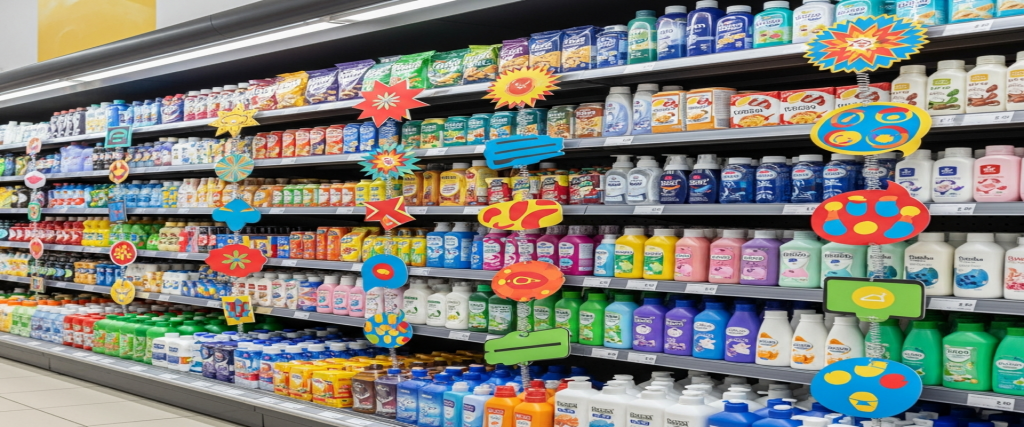
Wobblers and shelf talkers are the two most common kinds of small-format POS materials for the shelf, which marketers and merchandisers often confuse with each other. Both work on the same "territory", the retail shelf, but they do different jobs and are attached differently. This article covers the construction, standard sizes, materials, runs and prices of wobblers and shelf talkers for the Uzbekistan market.
What a Wobbler Is and How It Works
A wobbler is an advertising card with an image or a short message fixed on a flexible plastic stem-holder. The stem is inserted into a price tag holder or attached directly to the shelf with a clip. When the air moves or it is lightly touched, the card "wobbles" and catches the shopper's eye, hence the name (from the English "wobble", to sway).
The construction consists of two elements: a face card (full-color print, lamination) and a flexible PVC stem 0.3-0.5 mm thick. The stem is either glued to the card or inserted into a slot. The stem height varies from 5 to 15 cm depending on the task: raise the card above the level of the goods or keep it level with the price tag.
Wobblers are used to highlight a specific item: a promotional product, a new arrival, a "bestseller". To learn more about which other formats work on the shelf, read the article types of POS materials for retail.
Standard Wobbler Sizes
| Format (W×H), mm | Typical use | Stem length, mm |
|---|---|---|
| 70 × 100 | Small shelves, pharmacies, alcohol | 50–70 |
| 90 × 130 | Supermarkets, middle shelf tier | 70–100 |
| 100 × 150 | The most common FMCG format | 70–120 |
| 120 × 170 | Large items, top shelves | 100–150 |
Non-standard sizes are possible from a run of 500 pcs. For smaller runs it is more economical to stick to the standard: this shortens prepress time and lowers the unit cost.
What a Shelf Talker Is and Why It Is Needed
A shelf talker ("talking shelf") is a horizontal strip attached to the end or front edge of a shelf. Its main function is zoning: a shelf talker visually separates the brand's space from competitors' products and sets a single brand style along the whole row. The secondary function is informing: a promotion, SKU navigation, a promo price.
Structurally it is a flat strip with no moving parts. It is attached with double-sided tape, into the slots of a price tag holder or into special clamping profiles. A shelf talker does not "sway": it is static and works for coverage rather than for pinpoint highlighting. To see how shelf talkers fit into the overall POSM system, read the article POSM materials: what they are and how they increase sales.
Standard Shelf Talker Sizes
| Height, mm | Length, mm | Comment |
|---|---|---|
| 50 | 300 / 500 / 1000 | Pharmacies, cosmetics, small household chemicals |
| 60 | 500 / 1000 / 1500 | Grocery supermarkets, alcohol section |
| 70 | 500 / 1000 / 1500 | FMCG brands with a wide assortment |
| 80 | 1000 / 1500 | Hypermarkets, DIY retail, large format |
Non-standard length is made in multiples of 100 mm. Minimum run from 20 linear meters (lin. m).
How a Wobbler Differs From a Shelf Talker
The two formats solve different tasks, although both belong to the "small-format POS for the shelf" category. Below is a comparison by key parameters.
| Parameter | Wobbler | Shelf talker |
|---|---|---|
| Placement | Protrudes above the product vertically / at an angle | A horizontal strip along the shelf edge |
| Function | Highlighting a specific SKU, a promotional marker | Zoning, row branding, navigation |
| Typical size | 100 × 150 mm (card) + stem 70-120 mm | Height 50-80 mm, length 300-1500 mm |
| Mounting method | Clip into a price tag holder, tape on the stem | Double-sided tape, profile, shelf-edge slot |
| Minimum run | from 100 pcs | from 20 lin. m |
| Main material | PVC 0.3-0.5 mm | PVC, coated cardboard 250-350 g/m² |
| Service life | 1-4 weeks (promotion / promo) | 1-6 months (seasonal / permanent branding) |
Production Materials
The choice of material affects rigidity, appearance and service life. The wrong material means deformed wobblers after a week or shelf talkers that delaminate from the humidity in the sales hall.
Wobbler Materials
The standard is PVC 0.3-0.5 mm thick. Matte PVC reduces glare under artificial lighting, which matters for grocery stores with fluorescent lamps. PET is used when increased transparency of the backing or a firmer fit of the stem is needed.
Shelf Talker Materials
A short comparison of the three most in-demand options:
| Material | Pros | Cons | Use |
|---|---|---|---|
| PVC 0.4-0.5 mm | Moisture-resistant, flexible, durable | More expensive than cardboard, harder to dispose of | Permanent branding, chains |
| Coated cardboard 300 g/m² | Low price, bright print, fast production | Afraid of moisture, creases with frequent replacement | Short-term promotions up to 4 weeks |
| PET with varnish | Transparency, rigidity, "gloss" effect | High cost, non-standard cutting | Premium segment, alcohol, cosmetics |
Runs, Lead Times and Cost in Tashkent
The unit cost falls non-linearly: a run of 500 pcs costs 30-40% less per unit than a run of 100 pcs. Below are approximate parameters for orders in Tashkent.
Wobblers: minimum run is 100 pcs. Approximate price for a run of 100-500 pcs is $0.20-0.40 per piece; from 1000 pcs, $0.12-0.18 per piece. The price includes full-color printing, lamination and the stem.
Shelf talkers: minimum run is 20 lin. m. Approximate price: cardboard shelf talker $1.5-2.0 per lin. m, PVC $2.2-3.0 per lin. m for a run from 50 lin. m. The price assumes digital or offset printing and cutting.
Lead time: 2-5 working days from layout approval. For runs of more than 5000 wobblers or 200 lin. m of shelf talkers, the lead time is agreed separately. A rush order (24-48 h) is possible if capacity is free, so ask when submitting a request.
| Tip Submit the layout as PDF/X-1a or AI with embedded fonts. This avoids corrections at the prepress stage and shortens the lead time by 1 working day. |
How to Place Wobblers and Shelf Talkers on the Shelf Properly
Even a well-made POS material loses effectiveness if installed incorrectly. Four working rules:
1. The line of sight is 110-160 cm from the floor. This is the eye level of the average shopper. A wobbler on the bottom shelf is seen only by those who crouch for the product, and that is not your traffic. The priority is the second and third tiers from the top.
2. A wobbler must not cover the product. The card should rise above the facing, not cover the label. The ideal position is a stem from a price tag holder, with the card 3-5 cm above the top edge of the package.
3. A shelf talker covers the full length of the brand block. A strip made of three 500 mm pieces looks worse than a single 1500 mm sheet. Order the length for the real display, not "just in case".
4. Rotate wobblers with every promotion. An old wobbler with an expired promotion annoys the shopper and lowers trust in the brand. Budget for replacement every 3-4 weeks with regular promos.
| Tip Combine them: the shelf talker sets the brand's perimeter on the shelf, the wobbler highlights the promotional SKU inside that perimeter. The combination works better than either tool alone. |
Frequently asked questions
What is the standard wobbler size for a supermarket?
The most common format is 100 × 150 mm with a 70-100 mm stem. It suits most racks with a shelf depth of 30 cm or more. For pharmacy and cosmetics shelves, 70 × 100 mm is more often chosen, as it covers less of the package.
Which material is best for a shelf talker?
If the promotion lasts up to 4 weeks, coated cardboard of 300 g/m²: quick and cheaper. If permanent branding for 3-6 months is planned, PVC 0.4-0.5 mm. In humid zones (fish, dairy) cardboard is not used, only PVC or PET.
What is the minimum run of wobblers and shelf talkers?
For wobblers, from 100 pieces. For shelf talkers, from 20 linear meters. At smaller volumes the economics do not work: the cost of prepress makes the unit unprofitable. Ask about the terms when requesting a quote.
How much does it cost to make wobblers in Tashkent?
Approximately: a run of 100-500 pcs costs $0.20-0.40 per piece, a run from 1000 pcs $0.12-0.18 per piece. The price depends on size, lamination, stem type and urgency. The final cost is set per the technical brief.
How is a wobbler different from a price tag?
A price tag carries mandatory price information and is regulated by trade standards. A wobbler is marketing material: it can carry a promotional message, a logo, a slogan, a product image. A wobbler does not replace a price tag but complements the display.
Can a shelf talker and a wobbler be placed on the same shelf at the same time?
Yes, and it is common practice. The shelf talker runs along the whole brand block, the wobbler goes on a specific SKU within that block. The main thing is not to overload the shelf: no more than 2-3 wobblers per linear meter, otherwise the effect is diluted.
Order Wobblers and Shelf Talkers from aeste.uz
The company aeste.uz makes wobblers and shelf talkers for FMCG brands, retail chains and advertising agencies in Tashkent. We work with runs from 100 pieces. Lead time is 2-5 working days from layout approval. A site visit for measurements and help with drafting the technical brief are free.
Submit a request on the website aeste.uz or write to us directly: a manager will reply within two hours during business hours. Specify the format, run and desired deadlines and get a cost estimate without waiting.
For tabletop advertising in cafés and HoReCa, consider table tents and menu holders.
We will make it to fit your task: turnkey POSM production with a cost and lead-time estimate.